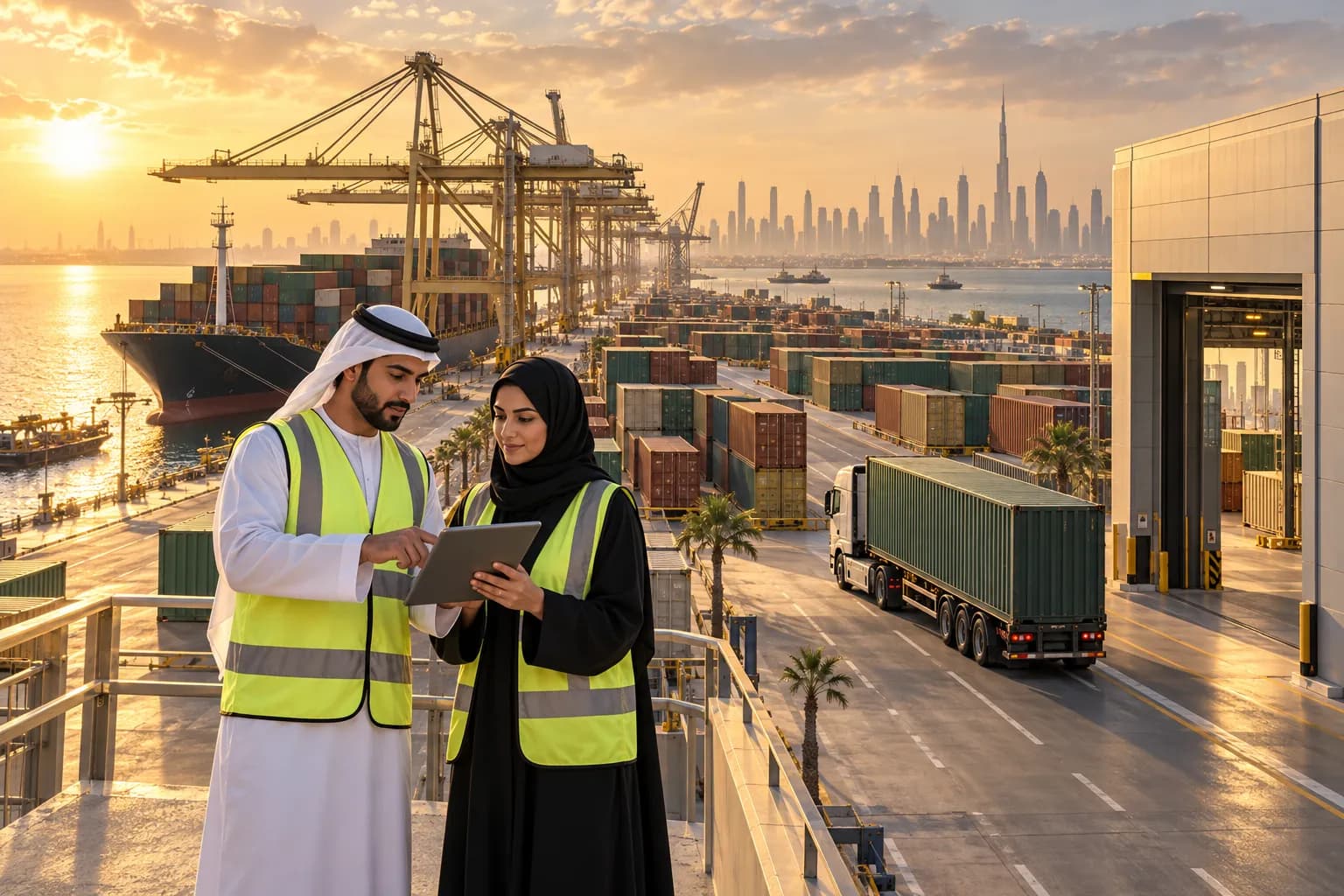

- Ship to the port nearest your warehouse: Jeddah for the west, Dammam for the Eastern Province and Riyadh.
- October 2026 quotes put LCL to Saudi Arabia at about USD 170–250 per cbm plus fees, and a 20ft container at USD 5,085–6,215. A 20ft starts to beat LCL at around 20 cbm.
- Your broker files the import declaration on FASAH. Duty is usually 5% of the CIF value, plus 15% VAT and a 0.15% customs fee.
- Regulated products need a SABER shipment certificate before the goods arrive. Ask your forwarder to check it before departure.
- The importer of record needs a Saudi CR. No local company? Use a forwarder or provider that offers importer-of-record or DDP service.
Saudi Arabia is the biggest ecommerce market in the Gulf, and getting your stock there is easier than it looks.
A good freight forwarder books the ship or plane, handles the paperwork and coordinates customs at Jeddah or Dammam, so you can focus on selling.
This page shows you which port to use, what freight costs in October 2026 and how Saudi clearance works. Then you'll find 11 independently researched forwarders that serve the Kingdom. For the wider region, see our main list of freight forwarders in the Middle East.
When do you need a freight forwarder in Saudi Arabia?
You need one as soon as you send stock in bulk to a Saudi warehouse. That might be your own store, a 3PL in Riyadh, Amazon FBA or noon FBN.
A forwarder plans the whole move. It books space with shipping lines and airlines, arranges the clearance at the Saudi port and trucks the goods to your door.
You'll want one when:
- You restock a warehouse. Cartons, pallets or containers, not single parcels.
- You buy from factories abroad. Someone has to consolidate cartons and book the ocean or air leg.
- Your goods need certificates. SABER and SFDA paperwork must be ready before arrival.
- You don't have a Saudi company yet. Some forwarders can act as importer of record for you.
Sending single parcels straight to shoppers? A courier or a cross-border parcel line is simpler. Our guide to shipping from China to Saudi Arabia compares every mode, from express to full containers.
Which Saudi port should your freight use?
Ship to the port closest to where your stock will live. Most sea cargo from China lands at Jeddah or Dammam, and each serves a different half of the country.
| Jeddah Islamic Port | King Abdulaziz Port, Dammam | Riyadh (via Dammam) | |
|---|---|---|---|
| Coast | Red Sea | Arabian Gulf | Inland, about 400 km from Dammam |
| Best for | Jeddah, Makkah, Madinah and the west | Eastern Province | Riyadh and central Saudi Arabia |
| Typical sea transit from China | About 27 days from Shanghai | About 22 days from Guangzhou | Dammam transit plus an inland truck or rail leg |
| 2026 rate trend | Most exposed to Red Sea disruption | Similar to Jeddah in Oct 2026; route passes Hormuz | Ask for a through-rate to Riyadh dry port |
| Main airport | JED | DMM | RUH |
Your warehouse is in Riyadh? Ask for a quote via Dammam straight through to Riyadh, by truck or the Saudi rail line. Forwarders also use Jubail, Yanbu and King Abdullah Port for some services.
By air, cargo lands at Riyadh, Jeddah or Dammam. Pick the airport nearest your warehouse to save a domestic truck leg.

How much does freight to Saudi Arabia cost in 2026?
Rates rose sharply in 2026 and still move week to week. Here's what forwarders were quoting from China in October 2026:
| Mode | Typical rate | Transit | Best for |
|---|---|---|---|
| FCL 20ft container | USD 5,085–6,215 | 22–30 days | About 20 cbm and up |
| FCL 40ft container | USD 6,615–9,500 | 22–30 days | Large restocks |
| LCL (shared container) | USD 170–250 per cbm, plus CFS and fixed fees | 25–35+ days | About 1–20 cbm |
| Air freight | USD 4.50–9.50 per kg | 2–7 days | Urgent or high-value stock |
| DDP sea line | USD 100–210 per cbm, door to door | 22–35 days | Sellers without a Saudi importer |
| DDP air line | USD 7–16 per kg, door to door | About 5–12 days | Small B2C parcels |
LCL quotes carry two extra layers. Expect a CFS (container freight station) fee of about USD 40–85 per cbm. Then add fixed documents, terminal handling and delivery-order fees of about USD 160–320 per shipment.
Worked example: LCL or a 20ft container to Dammam?
Say you're shipping 8 cbm of homeware from Shenzhen to Dammam. Here's how an LCL quote adds up next to a full 20ft box:
| Line | LCL (8 cbm) | 20ft container |
|---|---|---|
| Ocean freight | 8 × USD 170–250 = USD 1,360–2,000 | USD 5,085–6,215 |
| CFS handling | 8 × USD 40–85 = USD 320–680 | Not charged |
| Docs, THC and delivery order | USD 160–320 | Quoted separately |
| Total before clearance | USD 1,840–3,000 | USD 5,085–6,215 plus local charges |
At 8 cbm, LCL costs roughly 40% of a container. That gap closes quickly as your volume grows.
At around 20 cbm, the two options cost about the same. The ranges start to overlap from about 14 cbm, so ask for both prices once you get close.
Try your own cartons and destination port:
China → Gulf shipping cost estimator
Compare sea FCL, sea LCL, air freight and express for your shipment
For cost per unit
- Incl. CFS & docs (origin and destination CFS, docs, THC/D/O)
- Billed on 1 cbm = 1,000 kg, min 1 cbm
- Usually uneconomic above ~70 kg
Red Sea and Hormuz tensions pushed Gulf rates up sharply: a 40ft to Jeddah went from ~$3,250–3,650 (mid-2025) to $8,200–12,000 (Aug 2026), and Oct 2026 quotes still run $6,600–9,400. Quotes are valid for days, not months.
Freight only. Excludes customs duty (5% of CIF), 15% import VAT, SABER shipment certificate (SAR 350), origin/destination charges (except LCL CFS/docs) and inland delivery.
Indicative estimates based on forwarder quotes and market indices from Aug–Oct 2026; confirm with your forwarder.
The full tool, with notes on how it calculates, lives on our shipping cost estimator page. Use the result as a budget, then send the same specs to three forwarders for a firm quote.
How does Saudi customs clearance work?
Saudi clearance runs through FASAH, the online single window of ZATCA (the Zakat, Tax and Customs Authority). A licensed customs broker files your declaration there. Your forwarder either clears in-house or works with a broker it trusts.
Here's the flow for a typical commercial shipment:
- 1
Confirm the importer of record
The importer must hold a Saudi CR (commercial registration). No CR? Use a distributor, a marketplace programme, or a forwarder that offers importer-of-record or DDP service.
- 2
Classify your goods
Saudi Arabia uses 12-digit HS codes under the GCC tariff. Since May 2026, port manifests must show at least a 6-digit HS code and the cargo volume.
- 3
Get SABER certificates
Regulated products need a Product Certificate of Conformity (PCoC) and a Shipment Certificate of Conformity (SCoC) for every shipment. Both are issued on SABER, SASO's online platform, before the goods arrive.
- 4
Send the documents
Commercial invoice with country of origin, packing list, bill of lading or air waybill, certificate of origin, SABER certificates and any SFDA or CST permits.
- 5
Broker files on FASAH
Ideally 48 hours before arrival. SABER is linked to FASAH, so customs can see your certificates at the border.
- 6
Pay duty, VAT and fees
Paid online through FASAH or SADAD, Saudi Arabia's national bill-payment system.
- 7
Release and delivery
Green-lane shipments can clear in under two hours. If customs selects yours for inspection, allow another 2–5 business days. Then the goods are trucked to your warehouse.
SABER sounds like a lot, but for most sellers it becomes routine after the first shipment. The SCoC costs SAR 350 per shipment and stays valid for 90 days. The PCoC registration fee is SAR 500, plus the certification body's own charges.
If you're new to it, our SABER certificate guide walks through each step.
What will you pay at the border?
For most products, Saudi Arabia charges three things on the CIF value (cost, insurance and freight):
| Charge | Rate | On USD 10,000 of goods (CIF) |
|---|---|---|
| Customs duty | 5% for most lines | USD 500 |
| Import VAT | 15% of CIF plus duty | USD 1,575 |
| Customs service fee | 0.15% of CIF, SAR 15–500 per declaration | USD 15 |
| Total government charges | USD 2,090 |
Some HS codes carry a higher duty, so check your lines in the ZATCA tariff before you price your products. If your Saudi company is VAT-registered, you can usually reclaim the import VAT as input tax on your VAT return.
Freight forwarders serving Saudi Arabia
The companies below were independently researched and all serve Saudi Arabia. They aren't ranked, and the order isn't a recommendation.
The "Best for" line is our summary of where each company fits. The bullet points are what the company says about itself, or what the press has reported.
A quick guide to the mix:
- Saudi-based players. NAQEL Express is headquartered in Riyadh and says it is an Authorized Economic Operator (AEO) for Saudi customs, with in-house clearance.
- Global forwarders. DSV runs offices in Riyadh, Jeddah and Dammam, the company says, and offers online quotes through myDSV.
- China-origin specialists. Dantful publishes Saudi routes to Jeddah, Dammam and King Abdullah Port, including DDP.
- Regional and digital options. Aramex offers UAE–Saudi road freight, and Shipa Freight and Freightos give instant online rates you can use as a benchmark.
Dantful International Logistics
Best for: Chinese suppliers or Alibaba/1688 buyers wanting DDP sea/air consolidation into Jeddah, Dammam or Jebel Ali
- The company says it has contract rates with 10 shipping lines and fixed space with 9 airlines
- Says it runs 10 long-term warehouses in China and has agents in ~200 countries
- Publishes KSA guide: sea ~20-30 days, air ~2-7 days, DDP ~22-35 days (Shenzhen/Shanghai/Ningbo/Guangzhou to Jeddah/Dammam/King Abdullah Port)
YunExpress
Best for: Chinese cross-border sellers shipping small parcels B2C direct to GCC consumers
- The company says it handles 1M+ shipments per day to 220+ countries and regions
- Says it operates 4 self-operated B777F freighters plus an Atlas Air partnership
- Claims 95% on-time delivery and free pickup in 30+ Chinese cities
Sinotrans
Best for: Large China-origin B2B container shippers wanting a state-backed Chinese forwarder
- Site lists a 'Middle East' region in its global network (no country detail on homepage)
- Part of state-owned China Merchants Group; widely reported as one of China's largest forwarders by volume
Cainiao (Alibaba Group)
Best for: AliExpress and Alibaba ecosystem sellers shipping small parcels to the Gulf
- The company says its network covers 200+ countries and regions and 1,100+ warehouses worldwide
- Homepage lists Europe, SE Asia and North America as local service areas; Middle East not listed - confirm GCC coverage (AliExpress GCC flows run through Cainiao)
iMile
Best for: Chinese DTC/marketplace sellers needing cross-border plus COD last mile in KSA/UAE
- Founded 2017 in Dubai by Rita Huang; HQ Dubai Investment Park; R&D centres in Shenzhen and Hangzhou (press)
- US$40m Series A at ~US$350m valuation (Nov 2021) to expand across GCC, North Africa and Latin America (Wamda)
- 500+ staff and 25+ warehouses across the Middle East and China as of Oct 2020 (The National); newer figures not published
DSV (incl. former Agility Global Integrated Logistics and DB Schenker)
Best for: Established brands moving regular FCL/air volumes from China, Europe or US into the GCC
- The company says it has 3,000+ offices and logistics facilities in 90+ countries and ~150,000 employees
- Offers myDSV for online quoting, booking and tracking
Kuehne+Nagel UAE
Best for: Brands wanting one global forwarder for China-origin sea plus UAE warehousing
- UAE site lists customs clearance, fulfilment, cold chain and 4PL as services
Aramex Freight
Best for: Sellers who want freight, customs clearance and GCC last-mile delivery from one regional provider
- Wikipedia: ~16,300 employees (2025), revenue ~US$1.73bn (2025), listed on DFM; ADQ majority owner since 2025
- The company offers road freight between the UAE and Saudi Arabia alongside air and sea
Shipa Freight (Agility)
Best for: SMEs that want to book China-to-GCC LCL/air online without negotiating
- The company says it serves 100+ countries for air/ocean freight with real-time online rates, booking and payment
- Cites a 2.2m sqm warehousing footprint and 500+ vehicles (Agility network)
Freightos Marketplace
Best for: Benchmarking China-to-Jebel Ali/Jeddah rates before negotiating with a forwarder
- The company reports Q1 2026: 425K transactions, 79 carriers, 20.6K unique buyers, $343M GBV
- Says 4,000+ forwarders use its tools; SOC 2 Type II and ISO 27001
NAQEL Express
Best for: Cross-border e-commerce into KSA needing in-house clearance plus nationwide delivery
- The company says it is an Authorized Economic Operator (AEO) for Saudi customs
- Network map lists 15-16 countries including China (Hong Kong)

What should you ask a Saudi forwarder before you book?
Send these questions to every forwarder on your shortlist before you sign anything. Clear, written answers are a good sign, and vague ones tell you just as much.
Need clearance only, because you already have a forwarder at origin? Compare customs brokers in Saudi Arabia instead.
Notes for Chinese sellers
- Buy FOB. Supplier-arranged CIF often comes with high destination charges in Jeddah or Dammam.
- Label at the factory. Saudi Arabia wants "Made in China" on products, inner packs and outer cartons, plus Arabic consumer labels.
- New label rule. Since October 2026, products under ten SASO technical regulations must show the supplier's name and CR number.
- Plugs matter. Electricals need the Saudi three-pin plug (BS 1363).
- Parcel lines for B2C. DDP air lines bundle freight, clearance and last mile, and many collect cash on delivery.
The full route, from factory to Riyadh, is in our guide to selling in Saudi Arabia from China.
Notes for UAE-based sellers
- Truck it. Aramex, NAQEL and Shipa run road freight from the UAE into the Kingdom.
- Expect a second declaration. Goods from the UAE are declared again at the Saudi border, where 15% VAT is charged. Stock leaving a Dubai free zone pays Saudi duty there, and duty already paid in the UAE can be credited, though refunds are slow.
- SABER still applies. Goods cleared in Dubai still need Saudi conformity certificates before they cross the border.
- Hold stock where it sells. If most of your orders come from Saudi shoppers, a Riyadh warehouse usually means faster delivery than trucking every order from Dubai.
See our guide to shipping from Dubai to Saudi Arabia for costs and transit times.
Notes for Amazon and noon sellers
- Book the slot. Amazon and noon fulfilment centres in Saudi Arabia only accept deliveries with a booked appointment, so ask your forwarder to handle the booking.
- Label before departure. Apply carton and unit labels at origin, not at the Saudi port.
- Ship peak stock early. Ramadan and White Friday slots fill fast.
Get freight quotes for Saudi Arabia
Share your shipment details once. We'll match you with forwarders that fit your route, port and volume.
Frequently asked questions
There's no single best one. It depends on your route and volume. China-origin specialists suit Alibaba buyers, global forwarders suit regular container volume, and regional players such as NAQEL or Aramex suit sellers who want clearance and delivery under one account. Shortlist two or three types and compare all-in quotes.
Sources & further reading
- Shipping from China to Saudi Arabia (October 2026) — Welltrans Logistics
- Shipping from China to Saudi Arabia — Dantful International Logistics
- Customs Clearance in Saudi Arabia: Complete Guide 2026 — Bahkali Logistics
- E-Store Customers (customs rules for online purchases) — Zakat, Tax and Customs Authority (ZATCA)
- ZATCA customs service fee announcement — Zakat, Tax and Customs Authority (ZATCA)
- SABER product and shipment conformity platform — Saudi Standards, Metrology and Quality Organization (SASO)
- Shipping to Saudi Arabia (updated January 2026) — ForwardMe
This guide is for general information only and is not legal, tax or financial advice. Rules and fees change — always confirm with the official source or a licensed advisor.

Maya is MiddleEastEcom's lead guide and editor. She researches GCC marketplaces, payments and regulations and turns them into practical playbooks for sellers.
Meet Maya