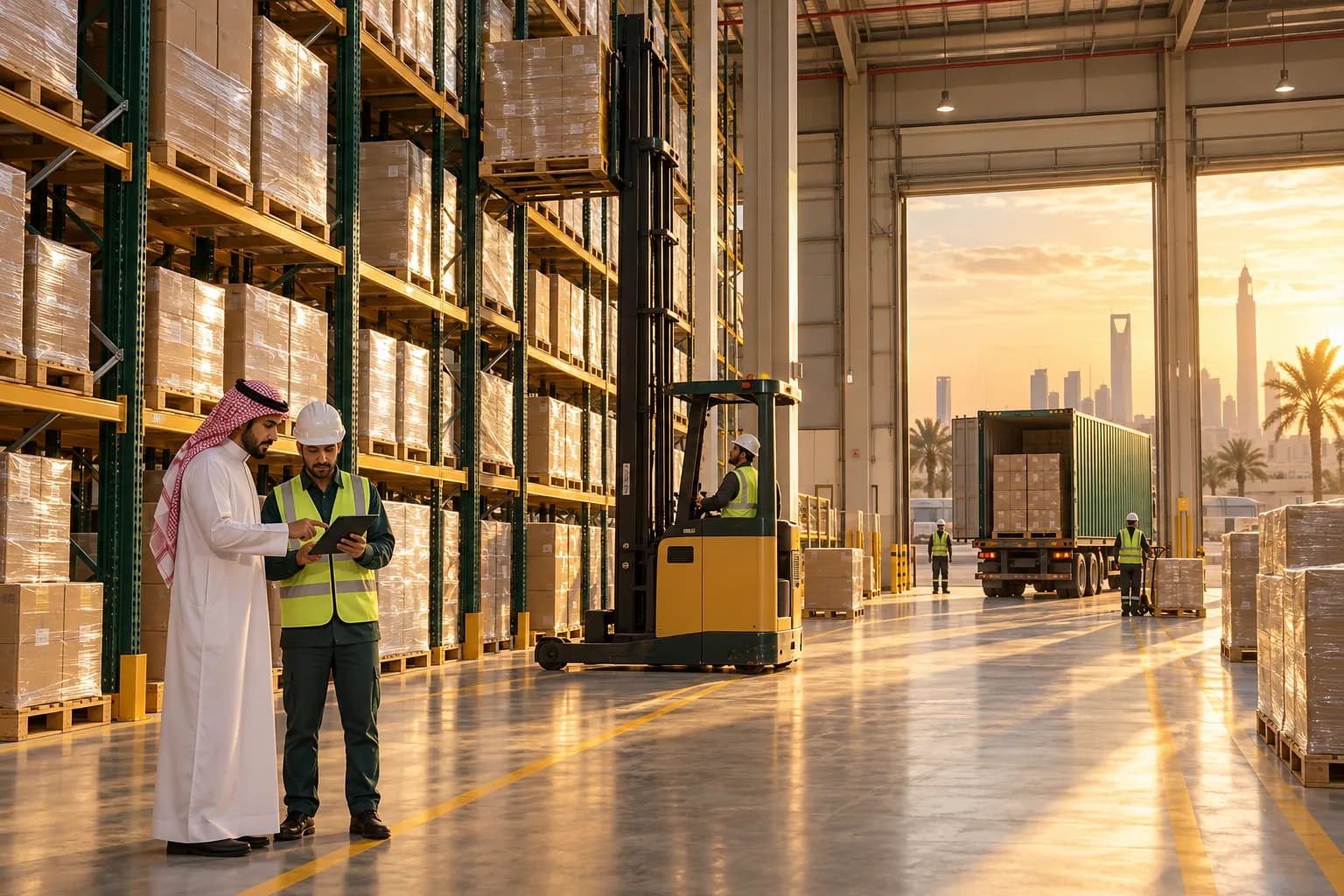

- You need a forwarder once you ship stock in cartons or containers. Single parcels can go by courier or a parcel line.
- Match the forwarder type to your route: China specialists for Alibaba sourcing, global forwarders for steady container volume, regional players for UAE–Saudi trucking.
- Compare all-in quotes to your warehouse door. Port charges, delivery orders and clearance often decide which quote is really cheaper.
- Confirm who acts as importer of record before you book. In Saudi Arabia that party needs a Saudi CR.
- Book a small trial shipment first and measure transit time and damage before you commit volume.
A good freight forwarder is the difference between stock that lands on time and stock stuck at port.
The good news? The Gulf is one of the best-connected trade hubs on earth. Dubai's Jebel Ali alone runs 80+ weekly services to over 150 ports.
So you have plenty of choice. The trick is picking the right type of forwarder for your shipment, then comparing quotes properly.
You'll find 11 independently researched forwarders below, plus a 7-step way to choose, the pricing models you'll see and the questions to ask before you book. It's part of our directory of GCC service providers.
When do you need a freight forwarder?
You need one as soon as you ship stock in bulk: cartons, pallets or containers going to a warehouse. A forwarder books the space, handles the paperwork and coordinates customs clearance at both ends.
Think of a forwarder as your travel agent for cargo. It doesn't own the ships or planes. It knows which ones to book, and it gets better rates than you would alone.
You'll want a forwarder when:
- You're restocking a warehouse. For example, a Saudi 3PL, a Dubai free-zone store, or Amazon FBA and noon FBN.
- You're shipping more than a few cartons. Past roughly 100 kg, air cargo and LCL beat courier rates.
- Your goods need certificates. SABER in Saudi Arabia or ECAS in the UAE has to be ready before arrival.
- You buy from factories in China. Someone has to consolidate cartons from several suppliers and book the ocean leg.
Do you always need one? No.
If you send single parcels straight to shoppers, a courier or a cross-border parcel line is simpler. Our comparison of freight forwarders vs couriers shows where the line falls.
Which type of freight forwarder fits your business?
GCC sellers usually pick from five types of forwarder. Each one is strong on a different route or shipment size.
| Best for | Examples | How you book | |
|---|---|---|---|
| China-origin specialists | Alibaba and 1688 buyers, consolidated sea and air, DDP into Jebel Ali, Jeddah or Dammam | Dantful, Sinotrans | Quote by email or WeChat |
| China–Gulf parcel lines | Small B2C parcels straight to Gulf shoppers, often with COD | YunExpress, Cainiao, iMile | Online account, per-kg rate |
| Global forwarders | Regular container or air volume from China, Europe or the US | DSV, Kuehne+Nagel | Account manager or online portal |
| Regional GCC players | UAE–Saudi trucking, clearance and last mile under one account | Aramex, NAQEL | Quote or online booking |
| Digital marketplaces | Instant quotes, online booking and rate benchmarking | Freightos, Shipa Freight | Book and pay online |
Here's a simple rule of thumb:
- First shipment from China? Start with a China-origin specialist or a digital marketplace.
- Selling parcel by parcel? Use a parcel line.
- Shipping a container a month? Talk to a global or regional forwarder and negotiate a contract rate.
Freight forwarders serving Saudi Arabia and the UAE
The companies below were independently researched. They aren't ranked, and the order isn't a recommendation.
On each card, the "Best for" line is our summary of where the company fits. The bullet points are what the company says about itself, or what the press has reported.
How do you use the list? Find your forwarder type in the table above, then pick two or three cards that match it. Add one digital marketplace quote as a price benchmark.
Dantful International Logistics
Best for: Chinese suppliers or Alibaba/1688 buyers wanting DDP sea/air consolidation into Jeddah, Dammam or Jebel Ali
- The company says it has contract rates with 10 shipping lines and fixed space with 9 airlines
- Says it runs 10 long-term warehouses in China and has agents in ~200 countries
- Publishes KSA guide: sea ~20-30 days, air ~2-7 days, DDP ~22-35 days (Shenzhen/Shanghai/Ningbo/Guangzhou to Jeddah/Dammam/King Abdullah Port)
YunExpress
Best for: Chinese cross-border sellers shipping small parcels B2C direct to GCC consumers
- The company says it handles 1M+ shipments per day to 220+ countries and regions
- Says it operates 4 self-operated B777F freighters plus an Atlas Air partnership
- Claims 95% on-time delivery and free pickup in 30+ Chinese cities
Sinotrans
Best for: Large China-origin B2B container shippers wanting a state-backed Chinese forwarder
- Site lists a 'Middle East' region in its global network (no country detail on homepage)
- Part of state-owned China Merchants Group; widely reported as one of China's largest forwarders by volume
Cainiao (Alibaba Group)
Best for: AliExpress and Alibaba ecosystem sellers shipping small parcels to the Gulf
- The company says its network covers 200+ countries and regions and 1,100+ warehouses worldwide
- Homepage lists Europe, SE Asia and North America as local service areas; Middle East not listed - confirm GCC coverage (AliExpress GCC flows run through Cainiao)
iMile
Best for: Chinese DTC/marketplace sellers needing cross-border plus COD last mile in KSA/UAE
- Founded 2017 in Dubai by Rita Huang; HQ Dubai Investment Park; R&D centres in Shenzhen and Hangzhou (press)
- US$40m Series A at ~US$350m valuation (Nov 2021) to expand across GCC, North Africa and Latin America (Wamda)
- 500+ staff and 25+ warehouses across the Middle East and China as of Oct 2020 (The National); newer figures not published
DSV (incl. former Agility Global Integrated Logistics and DB Schenker)
Best for: Established brands moving regular FCL/air volumes from China, Europe or US into the GCC
- The company says it has 3,000+ offices and logistics facilities in 90+ countries and ~150,000 employees
- Offers myDSV for online quoting, booking and tracking
Kuehne+Nagel UAE
Best for: Brands wanting one global forwarder for China-origin sea plus UAE warehousing
- UAE site lists customs clearance, fulfilment, cold chain and 4PL as services
Aramex Freight
Best for: Sellers who want freight, customs clearance and GCC last-mile delivery from one regional provider
- Wikipedia: ~16,300 employees (2025), revenue ~US$1.73bn (2025), listed on DFM; ADQ majority owner since 2025
- The company offers road freight between the UAE and Saudi Arabia alongside air and sea
Shipa Freight (Agility)
Best for: SMEs that want to book China-to-GCC LCL/air online without negotiating
- The company says it serves 100+ countries for air/ocean freight with real-time online rates, booking and payment
- Cites a 2.2m sqm warehousing footprint and 500+ vehicles (Agility network)
Freightos Marketplace
Best for: Benchmarking China-to-Jebel Ali/Jeddah rates before negotiating with a forwarder
- The company reports Q1 2026: 425K transactions, 79 carriers, 20.6K unique buyers, $343M GBV
- Says 4,000+ forwarders use its tools; SOC 2 Type II and ISO 27001
NAQEL Express
Best for: Cross-border e-commerce into KSA needing in-house clearance plus nationwide delivery
- The company says it is an Authorized Economic Operator (AEO) for Saudi customs
- Network map lists 15-16 countries including China (Hong Kong)
Need a forwarder for one country? See our lists of freight forwarders in Saudi Arabia and freight forwarders in the UAE.

How do you choose a freight forwarder in 7 steps?
Start with your shipment, not with the forwarder. Once you know the mode, the trade terms and who will import the goods, the shortlist almost writes itself.
- 1
Pick the shipping mode
Parcels for orders under about 30 kg each. Air cargo for urgent or high-value stock. LCL (shared container) for about 1–20 cbm. FCL (full container) above that.
- 2
Agree the Incoterm with your supplier
FOB or EXW means you hire and manage the forwarder. DDP means one all-in landed price. Many Alibaba and 1688 suppliers don't offer DDP by default, so ask.
- 3
Decide who is importer of record
The importer of record is legally responsible for the import. It can be you, your local company, the forwarder or an IoR provider. In Saudi Arabia it must hold a Saudi CR (commercial registration).
- 4
Check product compliance
SABER for SASO-regulated goods and SFDA for food, cosmetics and devices in Saudi Arabia. ECAS in the UAE. Ask whether the forwarder coordinates these or expects you to.
- 5
Request three quotes with identical specs
Same volume, weight, HS codes, origin port and delivery address. Otherwise you're comparing apples with camels.
- 6
Compare the all-in landed cost
Add origin charges, freight, surcharges, destination handling, delivery order, clearance, duty, VAT and trucking. The cheapest freight rate is often not the cheapest quote.
- 7
Run a trial shipment
Send a small first load. Measure transit time, communication and damage before you commit regular volume.
How do freight forwarders charge?
Most forwarders don't bill a separate service fee. Their margin sits inside the rates they quote, so it pays to understand how each line is calculated.
| Mode | How it's priced | What to watch |
|---|---|---|
| FCL (full container) | Per 20ft or 40ft container | Origin and destination handling, free days at port |
| LCL (shared container) | Per cbm or revenue ton | CFS consolidation and document fees, minimum charge |
| Air cargo | Per chargeable kg | The greater of actual or volumetric weight |
| Parcel lines | Per kg plus a per-piece fee | COD fees, failed-delivery and return costs |
| DDP | One per-kg or per-cbm all-in rate | How the goods are valued for duty and VAT |
On top of the base rate, expect a few surcharges:
- Fuel (BAF). A bunker adjustment that moves with oil prices.
- Peak season. Added when demand spikes, such as before Chinese New Year and the big Gulf sales.
- War risk. Red Sea and Gulf risk surcharges were common in 2026.
- Destination charges. Terminal handling, the delivery order (D/O) fee and storage.
What goes into an all-in quote?
An all-in quote covers every charge from the factory gate to your warehouse door. Check that each of these lines is either priced or clearly marked as excluded:
| Charge | What it is | Who usually quotes it |
|---|---|---|
| Origin pickup and export clearance | Collecting from the factory and clearing Chinese export customs | Included on EXW, the supplier's job on FOB |
| Main freight | The ocean, air or truck leg itself | Always quoted |
| Surcharges | Fuel, peak season and war-risk add-ons | Often listed separately |
| Destination handling | Terminal handling (THC) and the delivery order (D/O) fee | Often left out of "to port" quotes |
| Customs clearance | Your broker files the import declaration | Forwarder or a separate broker |
| Duty, VAT and fees | Government charges on the CIF value | Passed through at cost, or bundled on DDP |
| Delivery | Trucking to your warehouse, plus any appointment booking | Ask for it explicitly |
Two quotes can differ by hundreds of dollars on freight and still land at the same total. The destination lines usually decide it.
Container rates moved fast this year. Drewry's Shanghai–Jebel Ali benchmark hit USD 8,509 per 40ft container in September 2026, then October quotes eased by about 15%. So treat any quote as valid for days, not months.
Worked example: air or LCL for a first order?
Say you're shipping 10 cartons of home accessories from Shenzhen to a Riyadh warehouse. Each carton measures 60 × 40 × 40 cm and weighs 12 kg.
For air freight, forwarders charge the higher of actual and volumetric weight. Volumetric weight is length × width × height in cm, divided by 6,000.
| Line | Calculation | Result |
|---|---|---|
| Actual weight | 10 × 12 kg | 120 kg |
| Volumetric weight | 10 × (60 × 40 × 40 ÷ 6,000) | 160 kg |
| Chargeable weight (air) | The higher of the two | 160 kg |
| Air freight | 160 kg × USD 4.50–9.50 | USD 720–1,520 |
| Volume (sea) | 10 × 0.096 cbm | 0.96 cbm |
| LCL sea freight, all-in | 1 cbm × USD 210–335 + USD 160–320 fixed fees | ~USD 370–655 |
Sea is still cheaper, but at under 1 cbm the fixed fees eat much of the saving, and it adds about a month.
That's why many sellers fly orders this small and switch to LCL once they pass 1–2 cbm. Try your own cartons:
China → Gulf shipping cost estimator
Compare sea FCL, sea LCL, air freight and express for your shipment
For cost per unit
- Incl. CFS & docs (origin and destination CFS, docs, THC/D/O)
- Billed on 1 cbm = 1,000 kg, min 1 cbm
- Usually uneconomic above ~70 kg
Red Sea and Hormuz tensions pushed Gulf rates up sharply: a 40ft to Jeddah went from ~$3,250–3,650 (mid-2025) to $8,200–12,000 (Aug 2026), and Oct 2026 quotes still run $6,600–9,400. Quotes are valid for days, not months.
Freight only. Excludes customs duty (5% of CIF), 15% import VAT, SABER shipment certificate (SAR 350), origin/destination charges (except LCL CFS/docs) and inland delivery.
Indicative estimates based on forwarder quotes and market indices from Aug–Oct 2026; confirm with your forwarder.
Use the result as a budget range. Then send the same specs to three forwarders for a firm quote, or follow our full guide to shipping from China to Saudi Arabia.
What should you ask before you book?
Ask these questions to every forwarder on your shortlist. Clear, written answers are a good sign; vague ones are your answer too.
Do you need a customs broker as well?
Usually not as a separate hire. Most forwarders on this page clear customs themselves or work with a broker they trust, and bundle it into the quote.
A separate broker makes sense in two cases:
- You already have a forwarder at origin that doesn't operate in the Gulf.
- You import complex or regulated goods and want a specialist who handles SFDA or SABER queries every day.
Either way, the broker files your declaration in the name of the importer of record. If you don't have a local company, that's the gap an importer of record service fills. You can also compare customs brokers in the Middle East.
Saudi Arabia or the UAE: where should your freight land?
Your forwarder needs to know where the stock will live. The ports, taxes and import rules differ between the two biggest Gulf markets.
Most China cargo lands at Jeddah on the Red Sea or Dammam on the Gulf. For a Riyadh warehouse, ask for a quote via Dammam straight through to Riyadh.
- Duty is usually 5% of the CIF value, plus 15% import VAT and a 0.15% customs fee.
- The importer of record needs a Saudi CR, or you use an IoR or DDP service.
- Regulated goods need a SABER shipment certificate (SAR 350) for every commercial shipment.
See our Saudi forwarder list.
Serving both markets from one hub? Many sellers keep stock in a Dubai free zone and truck orders into the Kingdom. Our guide to shipping from Dubai to Saudi Arabia walks through that route.
Notes for Chinese sellers and China sourcing
- Buy FOB, not CIF. Supplier-arranged CIF often comes with high destination charges in Jeddah or Dammam.
- Ask for DDP lines if you sell direct to shoppers. Parcel lines bundle air freight, clearance and last mile into one per-kg price, and many collect COD.
- Consolidate in China. China-origin specialists combine cartons from several factories in Shenzhen, Ningbo or Guangzhou into one shipment.
- Labels matter. Saudi Arabia wants "Made in China" on products and packs, plus Arabic consumer labels.
The full route, company setup and payouts are covered in selling in Saudi Arabia from China.
Notes for Amazon and noon sellers
- Book the appointment. Amazon and noon warehouses only accept deliveries with a booked slot.
- Label before departure. Carton and unit labels should be applied at origin, not at the Gulf port.
- Confirm the importer. Marketplace programmes and some forwarders can act as importer for cross-border sellers.
- Plan for peaks. Ship Ramadan and White Friday stock early, because warehouse slots fill fast.
For inbound rules, see Amazon FBA in Saudi Arabia and noon fulfilment options.
Get freight quotes
Share your shipment details once. We'll match you with forwarders that fit your route and volume.
In this section
Frequently asked questions
A courier such as DHL or Aramex Express owns the whole parcel journey and prices per shipment. A forwarder books space with airlines, shipping lines and truckers for you, handles the paperwork and coordinates clearance. Forwarders get cheaper per kilo once you ship pallets or cartons in bulk.
Sources & further reading
- Shipping from China to UAE — Dantful International Logistics
- Shipping from China to Saudi Arabia — Dantful International Logistics
- Shipping from China to Saudi Arabia (October 2026) — Welltrans Logistics
- Chinese container rates rise 6% as port congestion increases — FreshPlaza (citing Drewry)
- Freight from China to UAE (October 2026) — Sino Shipping
- E-Store Customers (customs rules for online purchases) — Zakat, Tax and Customs Authority (ZATCA)
- SABER product and shipment conformity platform — Saudi Standards, Metrology and Quality Organization (SASO)
This guide is for general information only and is not legal, tax or financial advice. Rules and fees change — always confirm with the official source or a licensed advisor.

Maya is MiddleEastEcom's lead guide and editor. She researches GCC marketplaces, payments and regulations and turns them into practical playbooks for sellers.
Meet Maya