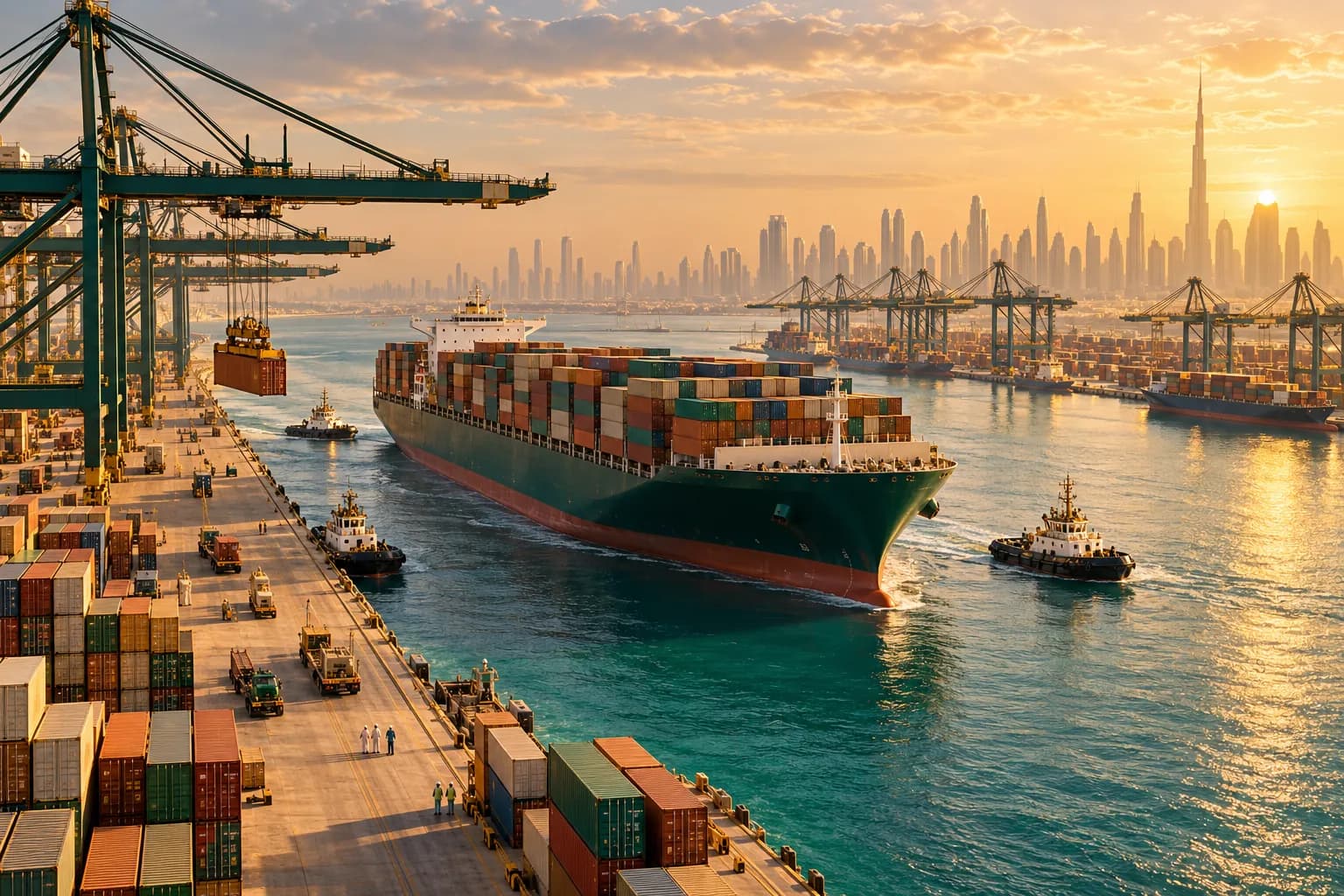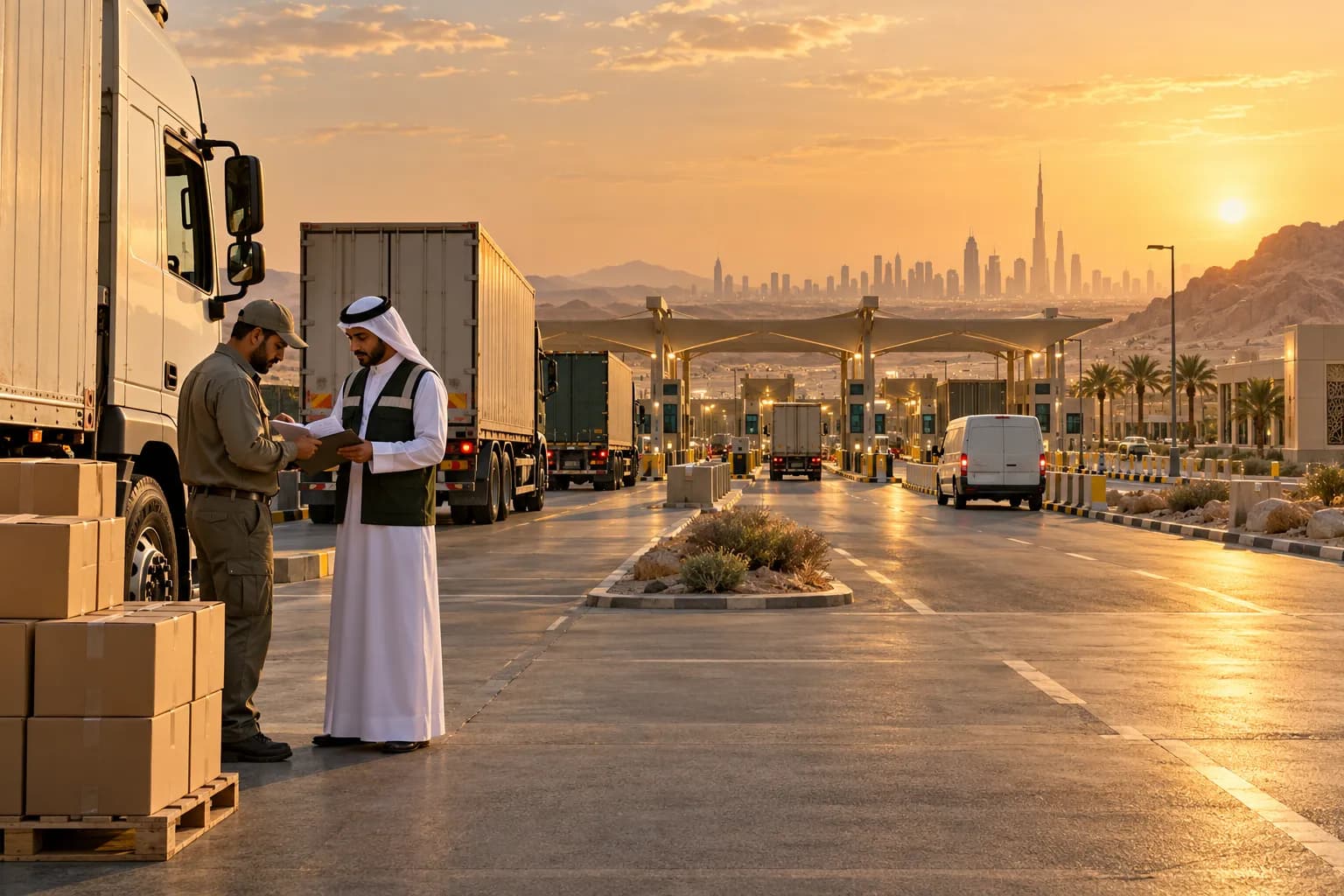

- Sea freight takes about 22–30 days port to port. Air takes 2–7 days and express 1–5 days.
- Container rates swung hard. A 40ft box on the Red Sea lane cost USD 8,200–12,000 in August 2026, roughly triple the mid-2025 price.
- Ship to Jeddah for the west and to Dammam for the Eastern Province and Riyadh. Compare all-in quotes to your door, not ocean rates.
- Plan on 5% duty and 15% import VAT, both on the CIF value. A 0.15% customs fee comes on top.
- Regulated products need a SABER Shipment Certificate (SAR 350) for every commercial shipment. No certificate, no clearance.
Shipping from China to Saudi Arabia is a well-trodden route. SHEIN, Anker and thousands of smaller Chinese brands already move stock into the Kingdom.
And the door is opening wider. Amazon's Middle East programme aims to bring in 10,000 new Chinese sellers a year.
Sea freight takes about a month, port to port. Air takes up to a week, and express couriers a few days.
Two things decide how smoothly it goes. Container rates to Jeddah roughly tripled between mid-2025 and August 2026, so a fresh quote matters. And most commercial shipments need a SABER certificate, which takes a few weeks to get right first time.
You'll see what each option costs, which port to pick and how to clear customs step by step, with two calculators and a worked example. It's part of our shipping guides for GCC sellers.
How much does shipping from China to Saudi Arabia cost?
It depends on how much you ship and how fast you need it. These are the five main options in late 2026.
| Sea FCL | Sea LCL | Air freight | Express courier | DDP e-commerce line | |
|---|---|---|---|---|---|
| Typical cost | 40ft: USD 2,500–3,650 (mid-2025) → USD 8,000–12,000 (Q3 2026) | ~USD 170–250/cbm (Oct 2026) + CFS and document fees | USD 4.50–9.50/kg | ~USD 13.50/kg (range USD 5–15) | Air USD 7–16/kg; sea USD 100–210/cbm, door to door |
| Transit | 20–30 days port to port | 25–35+ days (consolidation adds time) | 2–7 days | 1–5 days | ~5–12 days to the door (air) |
| Best for | More than ~20 cbm, restocking a Saudi 3PL or marketplace warehouse | 2–20 cbm, first test orders | Urgent or high-value stock, ~100–1,000 kg | Samples and parcels under ~70 kg | Parcels sold direct to Saudi shoppers |
| Who clears customs | Your broker via FASAH | Your broker via FASAH | Your broker via FASAH | Usually the courier | The line operator |
Pick by what you're shipping:
- Testing a product? Use LCL (less than container load), where you share a container with other shippers.
- Restocking a warehouse? Switch to FCL (full container load) once you fill about 20 cbm. Prices start to overlap from about 14 cbm, so get both quotes.
- In a hurry? Air freight is for urgent or high-value stock. Express is for samples.
- Selling direct to shoppers? A DDP e-commerce line is usually simplest.
Enter your weight, volume or carton sizes to price your own cargo.
China → Gulf shipping cost estimator
Compare sea FCL, sea LCL, air freight and express for your shipment
For cost per unit
- Incl. CFS & docs (origin and destination CFS, docs, THC/D/O)
- Billed on 1 cbm = 1,000 kg, min 1 cbm
- Usually uneconomic above ~70 kg
Red Sea and Hormuz tensions pushed Gulf rates up sharply: a 40ft to Jeddah went from ~$3,250–3,650 (mid-2025) to $8,200–12,000 (Aug 2026), and Oct 2026 quotes still run $6,600–9,400. Quotes are valid for days, not months.
Freight only. Excludes customs duty (5% of CIF), 15% import VAT, SABER shipment certificate (SAR 350), origin/destination charges (except LCL CFS/docs) and inland delivery.
Indicative estimates based on forwarder quotes and market indices from Aug–Oct 2026; confirm with your forwarder.
The estimator uses the same rates as the table. Use the result as your budget range, then ask forwarders for a firm quote.
Why container rates jumped in 2026
Red Sea risk, pricier ship fuel and US–Iran tensions all pushed rates up this year.
Drewry's Shanghai–Jebel Ali rate, the closest Gulf benchmark, hit USD 8,509 per container in September. That was up 13% in a single week.
Rates move that fast, so always ask for a fresh all-in quote.
Small parcels: DDP e-commerce lines
Selling straight to Saudi shoppers from China? Then look at a DDP e-commerce line.
DDP (Delivered Duty Paid) means the sender pays freight, duty and VAT. The buyer pays nothing at the door.
Chinese consolidators call these "special lines". One per-kg price covers air freight, clearance and last-mile delivery. Many also collect cash on delivery for you.
Low-value orders clear under the e-commerce rules. Personal orders under SAR 1,000 pay no duty. VAT at 15% and a flat SAR 15 fee still apply.
Ask the line operator to build both into its per-kg price. Your shoppers then pay nothing extra at the door.
Jeddah or Dammam: which port should you use?
Pick the port closest to where your stock will live. China cargo enters through three main gateways:
- Jeddah Islamic Port (Red Sea). It's the Kingdom's biggest container port. It serves Jeddah, Makkah, Madinah and the west. It's also exposed to Red Sea disruption, so its rates were the highest Gulf lane this year.
- King Abdulaziz Port, Dammam (Arabian Gulf). It serves the Eastern Province and Riyadh, about 400 km inland by truck or rail. Some forwarders quote straight through to the Riyadh dry port.
- Airports. Air cargo lands at Riyadh (RUH), Jeddah (JED) or Dammam (DMM).
Riyadh matters more than most sellers expect. About 44% of Saudi delivery orders go there.
So if you plan to use a fulfillment warehouse in Saudi Arabia, it will probably be in Riyadh. That makes Dammam the natural entry point for many sellers, so ask forwarders to quote Dammam straight through to Riyadh.
What does a shipment look like, step by step?
Take a typical sea shipment from a factory in south or east China to a Riyadh warehouse. Booking season and inspections can add a few days.
- Weeks −4 to −2Factory: book space and prepare documents
Confirm HS codes, SABER certificates and labels. In 2026, direct Red Sea space had to be booked 2–3 weeks ahead.
- Day 0Origin port: Shenzhen, Ningbo or Shanghai
Goods load at Shekou, Yantian, Ningbo or Shanghai. LCL cargo is first consolidated at a CFS warehouse.
- Days 1–30Ocean transit
About 22 days Guangzhou–Dammam or 27 days Shanghai–Jeddah. Watch for rollovers at transhipment hubs.
- ArrivalJeddah or Dammam port
Your broker should file the FASAH declaration at least 48 hours before arrival.
- +1–3 business daysFASAH customs clearance
Green lane takes under 2 hours. Red lane (physical inspection) adds about 2–5 business days.
- +1–4 daysLast mile to warehouse or customer
Truck or rail to Riyadh, then courier delivery. Every parcel needs a valid National Address.
The biggest delays rarely happen at sea. They happen when documents aren't ready before the ship arrives, so send your broker the full set a week before arrival.
How do you clear customs and SABER?
Saudi customs is a routine checklist, and well-prepared shipments clear in one to three business days. It all runs through FASAH, the single window of ZATCA (the Zakat, Tax and Customs Authority).
A licensed broker files your declaration on behalf of a Saudi importer.
The system also checks your SABER certificates. SABER is the online conformity platform of SASO, the Saudi standards body. Think of it as a passport for your product.
Sort all of it before the goods leave China, in this order:
- 1
Classify your product
Find the 12-digit HS code in the ZATCA Integrated Tariff. Check the duty rate. Then check who regulates the product: SASO, SFDA (food, cosmetics, supplements, medical devices) or CST (radio and telecom devices).
- 2
Arrange an importer of record
The importer of record is the party legally responsible for the import. It must hold a Saudi Commercial Registration (CR). That can be your own entity, a distributor, a marketplace programme or a forwarder's IoR or DDP service.
- 3
Get the product certificate (PCoC)
For SASO-regulated goods, an approved certification body issues a Product Certificate of Conformity. Registering it on SABER costs SAR 500, plus the body's own fees. Allow about 1–4 weeks.
- 4
Fix labels and marking
Mark “Made in China” on the product and on inner and outer packs. Use Arabic or Arabic/English consumer labels. Electricals need Saudi 3-pin plugs (BS 1363). From 1 October 2026, products under 10 technical regulations must show the supplier name and CR number.
- 5
Request the shipment certificate (SCoC)
Each commercial shipment needs a SABER Shipment Certificate (SAR 350, valid 90 days). It's issued against the PCoC and the commercial invoice, before the goods arrive.
- 6
Send complete documents to your broker
Commercial invoice (with country of origin), packing list, bill of lading or air waybill, certificate of origin, SABER certificates and any permits. Since May 2026, MAWANI also wants at least a 6-digit HS code and the cargo volume on manifests.
- 7
Pay duty, fees and VAT, then release
Pay duty (usually 5%), the 0.15% customs fee and 15% VAT through FASAH/SADAD. After release, the goods move to your warehouse.
Want the product-by-product rules? Read our guide to SABER and SASO certification.
How much will it cost to land your goods?
Your landed cost is everything you pay to get stock into the Kingdom. It starts with the CIF value: goods, insurance and freight.
Then you add duty and VAT, the customs fee and SABER fees. Local costs like brokerage, port handling and delivery come last.
VAT is charged on the CIF value plus the duty, not on the goods alone.
Try it with your own numbers:
GCC landed cost calculator
Duty, import VAT, customs fees and SABER costs for Saudi Arabia, the UAE and the wider GCC
GCC default is 5%. Check your HS code: some Saudi lines are 10-25%.
Your landed cost
- GoodsSAR 750
- Shipping + insuranceSAR 94CIF valueSAR 844
- Customs dutySAR 0
- Customs feesSAR 15
- Import VATSAR 129
- SABER (incl. VAT)SAR 0
- Total landed costSAR 988
- Under the de minimis threshold: no customs duty.
- Flat SAR 15 fee for online-store parcels up to SAR 1,000.
Estimates based on published ZATCA, Dubai Customs, SABER and GCC customs rules as of October 2026. VAT is charged on CIF + duty + customs fees. Confirm rates for your HS code with a licensed customs broker.
Worked example: a 4 cbm LCL shipment to Riyadh
Say a seller ships kitchen accessories from Shenzhen to Dammam by LCL. A truck then takes them to a Riyadh 3PL (third-party logistics warehouse).
We assumed the goods are SASO-regulated and pay the default duty. Insurance is 0.5% of the goods value. The exchange rate is the fixed peg of USD 1 = SAR 3.75.
| Line | Calculation | Amount |
|---|---|---|
| Goods (factory invoice) | 1,200 units × USD 5 | USD 6,000 |
| Ocean freight (LCL) | 4 cbm × ~USD 210 | USD 840 |
| Insurance (assumed) | 0.5% of goods | USD 30 |
| CIF value | USD 6,870 × 3.75 | SAR 25,763 |
| Customs duty | 5% × CIF | SAR 1,288 |
| Customs service fee | 0.15% × CIF (min 15, max 500) | SAR 39 |
| Import VAT | 15% × (25,763 + 1,288 + 39) | SAR 4,064 |
| SABER shipment certificate | SAR 350 + 15% VAT | SAR 403 |
| Landed before local charges | SAR 31,557 (~USD 8,415) |
So what does that mean per unit? Each one lands at about SAR 26.30, against a factory price of SAR 18.75. That's roughly 40% on top.
On top of that, you still pay CFS and document fees, broker fees, port handling and the truck to Riyadh. There's also the one-off PCoC registration.
The good news? If you're VAT-registered in Saudi Arabia, you can usually reclaim the import VAT as input tax. It hits your cash flow, not your margin.
What happens at the last mile?
Once cleared, your stock usually goes to a Saudi 3PL or a marketplace warehouse, such as Amazon FBA or noon FBN. Local couriers then deliver to your customers.
Since 1 January 2026, every parcel needs a valid Saudi National Address.
Couriers can refuse, hold or return parcels without one. So make the 8-character Short Address a required field at checkout.
Want to compare carriers, COD fees and coverage? See our guide to Saudi couriers.
Chinese brands selling here for the first time also need a company or importer route, marketplace accounts and payouts, all covered in selling in Saudi Arabia from China.
Freight forwarders for China–Saudi shipments
The forwarders below were independently researched and aren't ranked. The full list is in Saudi freight forwarders.
Before you book, ask each one three questions:
- Do you handle SABER coordination?
- Can you act as importer of record?
- Will you quote all-in to my door?
Dantful International Logistics
Best for: Chinese suppliers or Alibaba/1688 buyers wanting DDP sea/air consolidation into Jeddah, Dammam or Jebel Ali
- The company says it has contract rates with 10 shipping lines and fixed space with 9 airlines
- Says it runs 10 long-term warehouses in China and has agents in ~200 countries
- Publishes KSA guide: sea ~20-30 days, air ~2-7 days, DDP ~22-35 days (Shenzhen/Shanghai/Ningbo/Guangzhou to Jeddah/Dammam/King Abdullah Port)
YunExpress
Best for: Chinese cross-border sellers shipping small parcels B2C direct to GCC consumers
- The company says it handles 1M+ shipments per day to 220+ countries and regions
- Says it operates 4 self-operated B777F freighters plus an Atlas Air partnership
- Claims 95% on-time delivery and free pickup in 30+ Chinese cities
Sinotrans
Best for: Large China-origin B2B container shippers wanting a state-backed Chinese forwarder
- Site lists a 'Middle East' region in its global network (no country detail on homepage)
- Part of state-owned China Merchants Group; widely reported as one of China's largest forwarders by volume
Cainiao (Alibaba Group)
Best for: AliExpress and Alibaba ecosystem sellers shipping small parcels to the Gulf
- The company says its network covers 200+ countries and regions and 1,100+ warehouses worldwide
- Homepage lists Europe, SE Asia and North America as local service areas; Middle East not listed - confirm GCC coverage (AliExpress GCC flows run through Cainiao)
iMile
Best for: Chinese DTC/marketplace sellers needing cross-border plus COD last mile in KSA/UAE
- Founded 2017 in Dubai by Rita Huang; HQ Dubai Investment Park; R&D centres in Shenzhen and Hangzhou (press)
- US$40m Series A at ~US$350m valuation (Nov 2021) to expand across GCC, North Africa and Latin America (Wamda)
- 500+ staff and 25+ warehouses across the Middle East and China as of Oct 2020 (The National); newer figures not published
DSV (incl. former Agility Global Integrated Logistics and DB Schenker)
Best for: Established brands moving regular FCL/air volumes from China, Europe or US into the GCC
- The company says it has 3,000+ offices and logistics facilities in 90+ countries and ~150,000 employees
- Offers myDSV for online quoting, booking and tracking
Frequently asked questions
From booking to warehouse check-in, plan on about five to seven weeks by sea. That covers the ocean leg, clearance and the truck to your warehouse. By air, most shipments reach a Saudi warehouse within two weeks, clearance included.
Sources & further reading
- SABER product and shipment conformity platform — Saudi Standards, Metrology and Quality Organization (SASO)
- E-Store Customers (customs rules for online purchases) — Zakat, Tax and Customs Authority (ZATCA)
- New customs fee structure (news 1282) — Zakat, Tax and Customs Authority (ZATCA)
- Saudi Arabia Import Tariffs — U.S. International Trade Administration
- Chinese container rates rise 6% as port congestion increases — FreshPlaza (citing Drewry)
- Shipping freight rate from China: August 2026 market update — YQN
- Customs Clearance in Saudi Arabia: Complete Guide 2026 — Ahmed Bahkali Logistics
- Shipping from China to Saudi Arabia (October 2026) — Welltrans Logistics
This guide is for general information only and is not legal, tax or financial advice. Rules and fees change — always confirm with the official source or a licensed advisor.

Maya is MiddleEastEcom's lead guide and editor. She researches GCC marketplaces, payments and regulations and turns them into practical playbooks for sellers.
Meet Maya