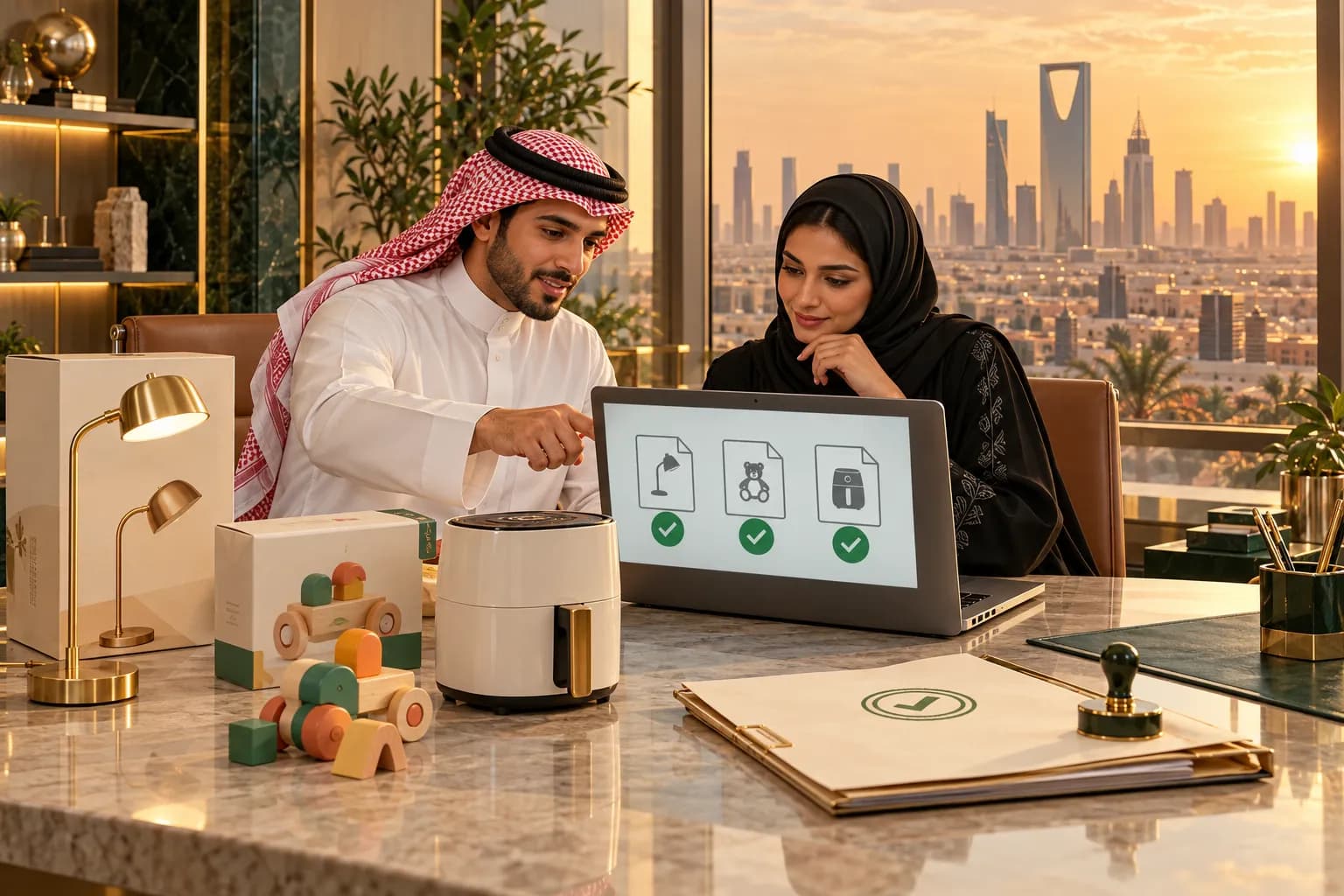

- The importer with a Saudi CR owns the SABER account. Your supplier sends documents; you submit the requests.
- Regulated products need a PCoC (SAR 500, valid one year). Every commercial shipment needs an SCoC (SAR 350, valid 90 days). Fees exclude VAT.
- Request the SCoC before the goods land. Letters of undertaking stopped being accepted in January 2025.
- Since 1 October 2026, products under ten technical regulations must show the supplier's name and CR number.
- Fewer, fuller shipments cut your SABER bill, because the SCoC fee is charged per shipment.
If you import products into Saudi Arabia to sell, SABER is your gatekeeper, and the good news is that the gate is almost entirely online.
SABER is the platform where you, the importer, prove your products meet Saudi safety rules. You open the account with your CR (commercial registration, your Saudi business licence). Then you register products, get certificates and link each shipment to them.
Done well, it becomes routine: most importers set it up once per product, then spend minutes on each new shipment.
This guide shows you how to run it from the importer's chair: the account, the certificates, the costs and what happens at the port.
What are SABER and SASO certificates?
SASO (the Saudi Standards, Metrology and Quality Organization) writes the safety rules. SABER is SASO's online platform where those rules are applied to real products and shipments. That's why people say "SASO certificate" and "SABER certificate" for the same thing.
You'll deal with two certificates:
- Product Certificate of Conformity (PCoC). One per product or model family, issued by a SASO-approved certification body after it checks the test reports. It usually lasts a year.
- Shipment Certificate of Conformity (SCoC). One per shipment, which you issue on SABER against your valid PCoCs.
The PCoC is the permanent pass for the product. The SCoC is the ticket for each trip it makes.
SABER is linked to FASAH, the Saudi customs platform, so the customs officer sees your certificates before the container is even unloaded.
Want the factory's side of the same process? See the SABER guide for Chinese exporters.
Does your product need a SABER certificate?
Almost every commercial import passes through SABER, but how strict the check is depends on the product.
Here's how products split:
- Regulated products. A SASO technical regulation covers them: electricals, electronics, toys, machinery, textiles, building products and more. You need a PCoC from an approved body, then an SCoC per shipment.
- Non-regulated products. No specific regulation applies, such as a wooden serving tray. You register a self-declaration on SABER, then issue the SCoC.
- Production inputs. Goods not meant for display to consumers, like raw materials for your workshop, have their own SABER track.
- Food, cosmetics and medical devices. These go to the SFDA (Saudi Food and Drug Authority), not SABER. See SFDA rules for cosmetics and food.
How do you find out which group you're in? Search your HS code (the customs tariff code) on SABER when you add the product, and the platform shows the regulation that applies.
Some goods can't come in at all, whatever certificate they hold. Check the list of prohibited and restricted imports to Saudi Arabia before you place the order.
How to get a SABER certificate, step by step
The first four steps happen once per product, and the last two repeat for each shipment.
- 1
Create your SABER account with your CR
Choose the importer track and enter your CR details. The Ministry of Commerce verifies them. Then name your facility type and the delegated person (often called the contact officer) on a signed, stamped form.
- 2
Add your products
Search by HS code or keyword and pick the closest description. Enter the brand, the model numbers and the manufacturer exactly as they appear on the invoice.
- 3
Choose a certification body and submit
Select a SASO-approved body for your product's regulation. Share the request number with your supplier so they can upload test reports and the technical file.
- 4
Pay and receive the PCoC
Pay the SAR 500 SABER fee plus the body's own fee. Once the body approves, the PCoC is registered under your account.
- 5
Request the SCoC before each shipment
Click New shipment request, give it a reference name, pick the certified products and add quantities and the commercial invoice. Pay SAR 350.
- 6
Hand over to your customs broker
Your broker files the declaration on FASAH. Customs reads the SCoC electronically, and the goods move to inspection or release.
How long does it take? Plan for one to four weeks for a first PCoC, depending on whether new testing is needed. An SCoC is usually ready within one to five working days.
How to choose a certification body
The certification body (SASO calls it a conformity assessment body, or CAB) is the one supplier in this process you pick yourself, and a good one saves you weeks.
Here's what to check before you click submit:
- Approval for your regulation. SABER only lists bodies approved for that technical regulation, and a body approved for toys may not be approved for electricals.
- Reuse of existing reports. Ask whether they'll accept your supplier's IECEE CB, EN or IEC reports, because re-testing is where the cost climbs.
- One certificate per model family. Ask whether one PCoC can cover several sizes or colours.
- A written quote. Body fees aren't fixed by SASO, so get them per product family and in writing.
Steer clear of anyone who offers a certificate without seeing test reports, because fake certificates lead to seized goods.
Compare bodies side by side in our product certification directory.
What changed in 2025 and 2026?
The rules tightened in four ways, and each one favours importers who plan ahead.
- Jan 2025No more letters of undertaking
Every commercial shipment now needs its certificates in place, with no promise to fix it after arrival.
- Sep 2026SCoC validity extended to 90 days
Up from 60 days, which gives you more room when a vessel is delayed.
- 1 May 2026USB Type-C charging port
Cameras, keyboards, mice and routers must now charge through USB Type-C, as phones have since January 2025. Laptops followed in April 2026.
- 1 Oct 2026Supplier name and CR on the label
Products under ten technical regulations must show the supplier's name and CR number. For imports, the supplier is you, the importer.
The label rule matters most right now, so brief your factory before the next production run to put your company name and CR on the product or its packaging. Our GCC product labelling guide covers the other label details.
What happens at the port?
Once the ship docks, three things happen fast. Your broker files the FASAH declaration, customs pulls up your SCoC and the risk system picks a lane.

- Green lane. The paperwork matches and no inspection is needed, so release can take under two hours.
- Red lane. Customs inspects the goods, which usually adds two to five business days.
- No valid certificate. The shipment can be refused and sent back at your cost.
You'll also pay import duty, a small customs service fee and 15% VAT through FASAH. See GCC customs duties for the rates.
What does SABER cost you each year?
SABER's own fees are fixed, while the certification body's fee varies from a few hundred to a few thousand US dollars per product family.
For example, take a Jeddah home-goods store importing two regulated products, an LED desk lamp and a children's toy. It ships six sea consignments a year.
| SABER cost item | Six shipments a year | Twelve shipments a year |
|---|---|---|
| PCoC registration (2 × SAR 500) | SAR 1,000 | SAR 1,000 |
| SCoCs at SAR 350 each | SAR 2,100 | SAR 4,200 |
| VAT at 15% on SABER fees | SAR 465 | SAR 780 |
| Yearly SABER total | SAR 3,565 | SAR 5,980 |
Doubling the shipments adds SAR 2,415 a year in SABER fees alone. Extra freight, broker and port charges come on top.
So consolidating into fuller containers pays twice, and the 90-day validity gives you room to time each shipment. Model your full per-unit cost with the landed cost calculator.
Notes for Amazon and noon sellers
Marketplaces check certificates too, especially for electricals, toys and other regulated categories.
- Keep PCoC numbers ready, because a category approval or listing review can ask for them.
- Amazon won't act as importer of record for cross-border stock going into FBA. Your CR, or a forwarder's IOR service, must hold the certificates.
- Issue an SCoC for every inbound shipment to FBA or FBN warehouses, even small top-ups.
- New to fulfilment? Start with Amazon FBA in Saudi Arabia.
Notes for UAE-based sellers
- Paying duty in Dubai doesn't clear SABER. Goods moving on to Saudi Arabia still need Saudi certificates.
- The UAE uses ECAS, run by MoIAT. Ask your certification body to quote ECAS, SABER and the GCC G-Mark together.
- Your Saudi importer must be the consignee on the truck paperwork when goods cross the border.
Notes for brands without a Saudi CR
No CR means no SABER account of your own, which is normal for a first launch.
- A Saudi distributor can import under its CR. Get a written agreement that the PCoCs registered for your products stay tied to them.
- An importer-of-record service imports in its name for a fee.
- Selling at scale? A Saudi company gives you full control. See Saudi business registration.
Find a certification body or broker
These independently researched bodies issue SABER certificates for Saudi importers.
SABER (SASO platform, official)
Best for: Every seller importing regulated goods to Saudi Arabia - start here
- Official SASO platform; required before regulated products enter KSA
- Fees: SAR 500 per product conformity certificate, SAR 350 per shipment certificate (excl. VAT)
- Shipment certificate validity extended from 60 to 90 days
SGS
Best for: Chinese factories and brands needing testing + SABER certificates from one global body
- SGS says it is a SASO-accredited certification body issuing SABER Product Certificates and Shipment Certificates, and can register products in SABER
- July 2025: SASO approval for the Communication and IT Devices regulation (phones, modems, laptops)
- Dense lab and inspection network in China
Intertek
Best for: Electronics and consumer goods exporters wanting testing and certification in China before shipping
- Runs government product-conformity programmes for several countries (company materials)
- Large China testing footprint
Bureau Veritas
Best for: Sellers with mixed product ranges (toys, textiles, electricals) needing one body for KSA and UAE
- Designatable as conformity assessment body in SABER: checks documents, tests samples, inspects factories where required; SASO-accepted CAB under SALEEM (2019 flyer)
- Says it is an accredited Notified Body approved by UAE MoIAT for ECAS and EQM certification
TÜV SÜD
Best for: Electronics/appliance brands with existing CB reports wanting SABER conversion
- TÜV SÜD Middle East says SASO approved it to issue SABER certificates; listed scopes include leather, textiles, footwear, accessories, paper/cardboard, paints and packaging
- July 2025: SASO notified body for the Communications and IT Devices regulation (wireless/radio and telecom product and shipment certificates)
- TÜV SÜD PSB (Singapore) is SASO-approved for Asia/Australia-made goods incl. textiles, batteries, detergents, low-voltage electricals
TÜV Rheinland
Best for: Chinese manufacturers already using TÜV for EU marks
- Large China product-testing presence (company materials)
Want someone to file the requests and clear the goods too? Compare customs brokers in Saudi Arabia, or browse the logistics hub.
Frequently asked questions
Not as a business importer. The commercial track starts with your CR data, which the Ministry of Commerce verifies. Individuals have a separate track for personal imports and vehicles, but it isn't meant for stock you plan to sell.
Sources & further reading
- SABER platform: fees, validity and announcements — Saudi Standards, Metrology and Quality Organization (SASO)
- Registering a product certificate of conformity (service page) — SABER
- SABER platform overview — Saudipedia
- SASO technical regulations list — SASO
- SASO conformity: PCoC and SCoC — QIMA
- Unified charging ports: USB Type-C phases — Communications, Space and Technology Commission (CST) and SASO
- Saudi Arabia testing, inspection and certification — US International Trade Administration
This guide is for general information only and is not legal, tax or financial advice. Rules and fees change — always confirm with the official source or a licensed advisor.

Maya is MiddleEastEcom's lead guide and editor. She researches GCC marketplaces, payments and regulations and turns them into practical playbooks for sellers.
Meet Maya