

- FBA means Amazon stores, packs, delivers and handles returns for you, and your listings get free two-day Prime delivery.
- The fee is set by size, weight and price. A standard parcel up to 1 kg costs SAR 10, or SAR 8 if it sells for SAR 25 or less.
- Storage is SAR 3 per cubic foot a month, so a small product costs well under SAR 1 a month to store.
- Amazon won't be your importer of record. Sellers from abroad ship DDP through their own Saudi entity or a forwarder's IOR service.
- For small and medium items, FBA costs about half as much per order as Easy Ship. Easy Ship wins for bulky, slow sellers.
Want your products on Prime in Saudi Arabia without renting a warehouse? That's what Amazon FBA does.
You send your stock to an Amazon fulfilment centre in the Kingdom. Amazon stores it, packs every order, delivers it with free two-day Prime shipping and handles the returns.
For a small product, it costs about SAR 10 an order. That's cheaper than shipping it yourself through Amazon's couriers.
Below you'll find what FBA costs, how to get your stock into a Riyadh or Jeddah warehouse, how to label it, and when Easy Ship is the better pick. It's part of our guide to selling on Amazon in the Middle East.
What is Amazon FBA in Saudi Arabia?
FBA (Fulfilment by Amazon) is Amazon's warehouse and delivery service for sellers. You do the selling. Amazon does everything after the customer clicks "Buy".
Here's what you get:
- The Prime badge. FBA listings get free two-day Prime delivery, which Saudi shoppers now expect.
- A better shot at the Buy Box. FBA offers often win the Featured Offer, and they're eligible for Lightning Deals.
- No warehouse or staff. Amazon picks, packs and ships every order.
- Customer service and returns. Amazon answers buyers and processes returns through its Online Returns Center.
- Cash on delivery handled. Amazon collects card, instalment and COD payments for you.
There's also no minimum quantity. You can send one carton to test a product.
New to Amazon.sa? Start with our step-by-step guide to selling on Amazon Saudi Arabia, then come back here when you're ready to ship stock.
How much does FBA cost on Amazon.sa?
You pay a fixed fee for each unit Amazon ships, plus a small monthly storage charge. The fulfilment fee covers picking, packing, delivery, customer service and returns.
The fee depends on three things: size, weight and price. Here are the most common tiers:
| Size tier | Price SAR 25 or less | Price above SAR 25 |
|---|---|---|
| Small envelope, up to 100 g | SAR 5.50 | SAR 7.50 |
| Standard envelope, up to 500 g | SAR 6.50 | SAR 8.50 |
| Standard parcel, up to 500 g | SAR 7.50 | SAR 9.50 |
| Standard parcel, up to 1 kg | SAR 8 | SAR 10 |
| Standard parcel, up to 2 kg | SAR 9 | SAR 12 |
| Standard parcel, up to 5 kg | SAR 12 | SAR 15 |
| Standard parcel, up to 12 kg | SAR 19 | SAR 22 |
| Oversize, up to 10 kg | SAR 19 | SAR 23 |
Notice the price break. Items that sell for SAR 25 or less pay SAR 2–4 less per order, which makes FBA work even for cheap accessories.
Storage fees
Storage costs SAR 3 per cubic foot a month, based on the average space your stock takes up each day.
For most products, that's small change. A shoebox-sized item takes about 0.2 cubic feet, so it costs about SAR 0.60 a month to store.
Storage only hurts when stock sits still. A long-term storage fee starts after 365 days, and dangerous goods such as aerosols pay extra.
Other FBA costs
A few more lines can appear on your statement:
- Referral fee. Amazon's commission on every sale, 3–16% by category. You pay it whichever way you ship.
- Removals and disposals. Getting unsold stock sent back or destroyed costs a fee per unit, charged as each unit leaves the warehouse. FBA New Selection waives it for eligible new products.
- VAT on fees. 15% VAT applies to every Amazon fee. You can reclaim it if you're VAT-registered.
The full fee picture, including Easy Ship and referral rates, is in our Amazon seller fees guide.
Worked example: what FBA leaves you on a SAR 69 product
Let's run real numbers. Say you sell an insulated lunch box for SAR 69, VAT included.
It weighs 0.7 kg and packs into a 22 × 16 × 10 cm box. It sells in home and kitchen, with a 14% referral fee.
Each unit sits in the warehouse for about two months before it sells.
| Per unit | FBA | Easy Ship |
|---|---|---|
| Referral fee (14%) | SAR 9.66 | SAR 9.66 |
| Delivery fee (up to 1 kg) | SAR 10.00 | SAR 20.50 |
| Storage, two months (0.12 cu ft) | SAR 0.75 | – |
| VAT on Amazon's fees (15%) | SAR 3.06 | SAR 4.52 |
| Amazon pays you | SAR 45.53 | SAR 34.32 |
FBA leaves you about SAR 11 more per sale, and you get the Prime badge on top. With Easy Ship, you'd also pay for your own storage and packing.
What do you actually keep? You owe ZATCA, the Saudi tax authority, SAR 9 of VAT on the sale. You reclaim the SAR 3.06 of VAT on Amazon's fees, so SAR 39.59 stays with you.
The lunch box lands in the warehouse at SAR 22 a unit, covering product, freight, duty and clearance. That leaves SAR 17.59 profit per sale with FBA.
Now try your own product. Change the price, category and size, then switch between FBA and Easy Ship:
Marketplace fee calculator
Amazon.sa, Amazon.ae and noon: see what you keep from every sale
Minimum referral fee: SAR 1.00 per item.
The price the shopper pays.
Landed cost: product, freight, duty.
Your numbers
Payout per unit
SAR 89.18What the marketplace transfers to you
Profit per unit
SAR 37.55Margin: 36.0% of price excl. VAT
- Referral fee(14.0% of price)
- SAR 16.80
- FBA fulfillment fee
- SAR 10.00
- VAT on fees (15.0%)(reclaimable)
- SAR 4.02
- Total marketplace fees
- SAR 30.82
- Net VAT you remit
- SAR 11.63
- Product cost
- SAR 40.00
Where the price goes
- Referral14.0%
- Fulfillment8.3%
- VAT on fees3.3%
- Net VAT9.7%
- Product cost33.3%
- Profit31.3%
Excludes storage, ads, returns and promotions. Estimates based on published Amazon (Aug 2025) and noon (Sep 2026) rate cards, as of 26 October 2026. Confirm with the marketplace before pricing.
Not sure what your landed cost is? Our landed cost calculator adds freight, 5% duty and 15% VAT for you.
How do you send stock to an Amazon.sa warehouse?
You create a shipping plan in Seller Central, label your cartons and book a delivery slot. Amazon tells you which fulfilment centre to deliver to.
Most Amazon.sa fulfilment centres are in and around Riyadh and Jeddah, plus one in Madinah. They use codes such as RUH3 and JED3. Always deliver to the address in your shipping plan, not one you used last time.
- 1
Set your listings to FBA
Create or match the listing in Seller Central, then switch the offer's fulfilment channel to Fulfilled by Amazon.
- 2
Prep and label your units
Print an Amazon barcode label for each unit and pack it to Amazon's packaging rules. More on this below.
- 3
Create a shipping plan in Send to Amazon
Enter your products, quantities and carton details. Amazon assigns the fulfilment centre and gives you shipment ID labels for each carton.
- 4
Book a Carrier Central appointment
Your carrier or forwarder books a delivery slot at the fulfilment centre. Deliveries without an appointment are turned away.
- 5
Ship DDP and track the receipt
Duty and VAT must be paid before the goods arrive. Once Amazon receives the cartons, check the counts in Seller Central.
How long does it all take? From China, sea freight takes about 22–30 days port to port, and air 2–7 days. Customs then takes one to three business days if your papers are in order.
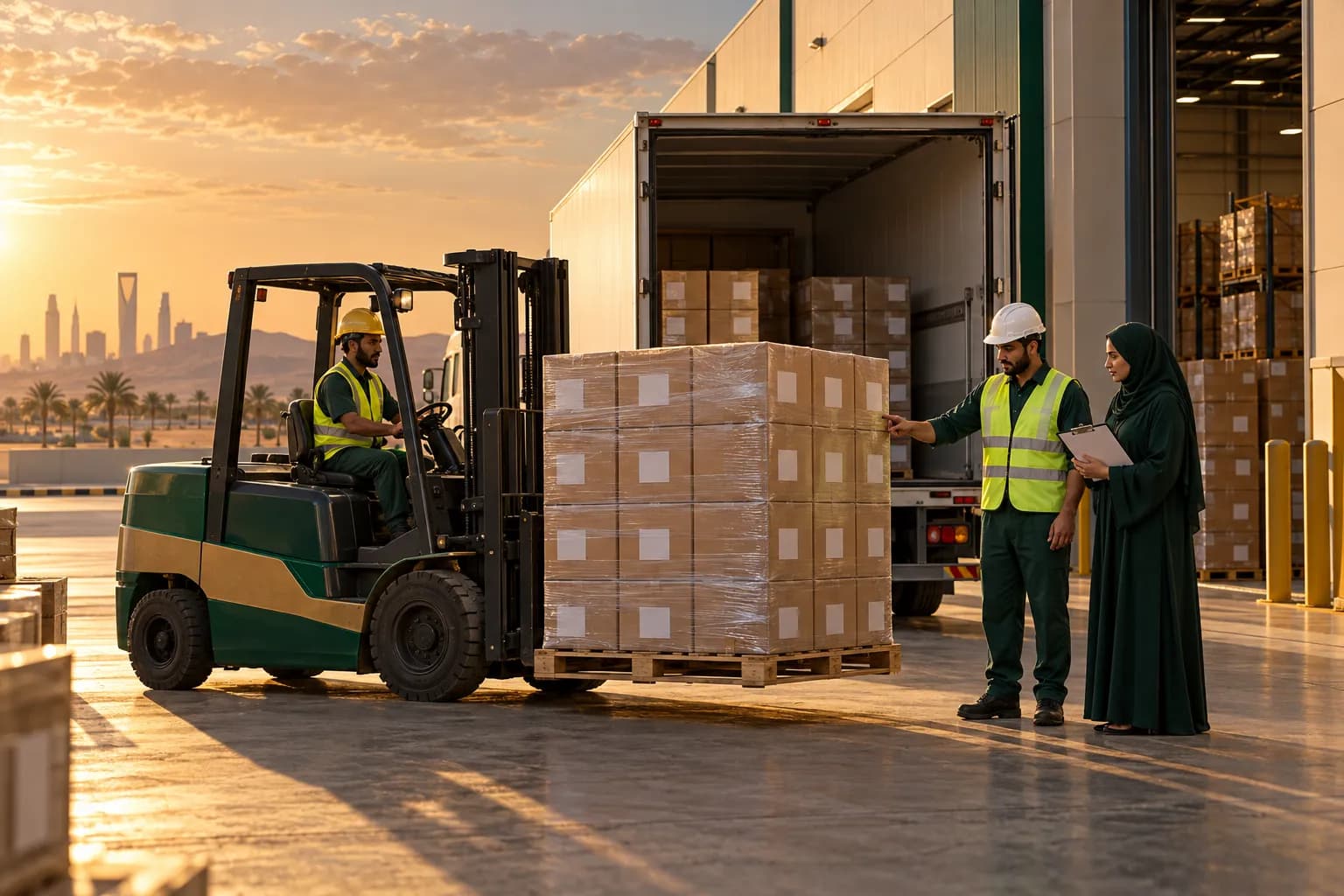
Shipping from China? Our China to Saudi Arabia shipping guide covers modes, costs and customs step by step.
How should you prep and label FBA stock?
Good prep is boring, and that's the point. Correctly labelled stock gets received quickly and goes on sale sooner.
Get these right:
- Unit labels. Each item carries an Amazon barcode (FNSKU) so the warehouse knows it's yours. Forwarders print them on 60 × 40 mm thermal labels.
- Carton labels. Every carton gets its own shipment ID label from your shipping plan.
- Carton size and weight. Forwarders shipping into Saudi FCs keep cartons under 22 kg and about 55 cm per side.
- Mixed cartons. If a box holds several products, list its contents in Send to Amazon.
- Saudi product labels. Show the country of origin and Arabic, or Arabic and English, consumer information.
Since October 2026, products under ten Saudi technical regulations must also show the supplier's name and CR number.
Most regulated products also need SABER certificates before they ship. Our SABER and SASO guide explains which ones and how to get them.
Selling from abroad? You need an importer of record
This is the step foreign sellers most often miss. Amazon won't act as importer of record (IOR) or consignee for FBA stock in Saudi Arabia, and it can reject shipments that name it.
The importer of record is the company that clears your goods through customs and pays the duty and VAT. You have two options:
- Your own Saudi entity. A Saudi company with a commercial registration imports the goods in its own name.
- A forwarder's IOR service. Many forwarders act as importer for non-resident sellers. This is how their DDP services work.
Either way, ship DDP (Delivered Duty Paid). Duty, usually 5%, and 15% VAT are paid before the goods reach Amazon. Fulfilment centres refuse deliveries with charges still due.
Need an IOR partner? Compare freight forwarders in Saudi Arabia that handle Amazon FBA deliveries.
FBA or Easy Ship: which should you pick?
For most products, FBA wins. It's cheaper per order on small and medium items, and only FBA gets the Prime badge.
With Easy Ship, you keep the stock and Amazon's courier collects each order from you. It costs SAR 19 up to 250 g and SAR 20.50 up to 1 kg, based on actual or volumetric weight, whichever is higher.
| FBA | Easy Ship | |
|---|---|---|
| Who stores and packs | Amazon | You |
| Fee, 1 kg parcel | SAR 10 | SAR 20.50 |
| Storage fee | SAR 3 per cubic foot a month | None |
| Prime badge | ||
| Charge the buyer for shipping | No | Up to SAR 12 |
| Returns and delivery questions | Amazon | Amazon (returns come back to you) |
| Best for | Most products, fast sellers, new launches | Bulky or slow sellers, quick tests |
So when does Easy Ship make sense? When storage outweighs the delivery saving.
For example, take a bulky item in a box the size of a small suitcase. It fills about 3.4 cubic feet, or roughly SAR 10 a month in storage.
If each unit sits for six months, storage adds about SAR 60 to every sale. Kept in your own store room, it adds nothing to your Amazon fees.
Easy Ship also suits a quick test before you commit stock. Our Amazon Easy Ship guide covers pickup and the full rate bands.
Amazon FBA Saudi Arabia launch checklist
Work through this before your first shipment leaves the factory:
Notes for foreign brands
Selling from the UK, Europe, the US or India? FBA is the easiest way to serve Saudi shoppers without a local warehouse.
- Register through Global Selling. Add Amazon.sa from the Sell Globally dashboard in your existing Seller Central.
- Book your IOR first. Choose a forwarder with an IOR and DDP service before you order stock.
- Get SABER early. Product certificates take about one to four weeks, so start them alongside your listings.
- Send a small first batch. Air-freight a few cartons to test, then switch to sea freight for restocks.
Notes for Chinese sellers
Amazon is courting Chinese sellers hard in the Gulf, and FBA is where most of the 2026 benefits sit.
- Claim the inbound cashback. New cross-border sellers get cashback on every unit received, up to SAR 3,754 per ASIN. The offer runs until 30 December. Units must arrive within 90 days of creating the shipment.
- Use Amazon SEND. It ships from China to Saudi FBA, with customs handled at both ends. Dangerous goods are excluded.
- Plan freight carefully. Shared-container (LCL) sea freight costs about USD 170–250 per cbm in late 2026. A 20ft container becomes cheaper from roughly 20 cbm.
Our guide to Amazon Middle East for Chinese sellers walks through registration and payouts.
Notes for UAE-based sellers
Already on FBA in the UAE? You can test Saudi demand before moving stock.
- Try Remote Fulfilment. Amazon's programme lets UAE FBA stock serve Saudi orders, so you can test demand first.
- Move fast sellers into Saudi. Once a product sells well, ship it to a Saudi FC for two-day Prime delivery.
- Budget for higher VAT. Saudi VAT is 15% against 5% in the UAE, so reprice your listings.
The Emirates side is covered in our Amazon FBA UAE guide.
Find a partner for your FBA shipments
A freight forwarder can collect from your factory, act as importer of record, pay duty and VAT, and deliver to the right fulfilment centre on time.
These forwarders were independently researched and aren't ranked:
Dantful International Logistics
Best for: Chinese suppliers or Alibaba/1688 buyers wanting DDP sea/air consolidation into Jeddah, Dammam or Jebel Ali
- The company says it has contract rates with 10 shipping lines and fixed space with 9 airlines
- Says it runs 10 long-term warehouses in China and has agents in ~200 countries
- Publishes KSA guide: sea ~20-30 days, air ~2-7 days, DDP ~22-35 days (Shenzhen/Shanghai/Ningbo/Guangzhou to Jeddah/Dammam/King Abdullah Port)
YunExpress
Best for: Chinese cross-border sellers shipping small parcels B2C direct to GCC consumers
- The company says it handles 1M+ shipments per day to 220+ countries and regions
- Says it operates 4 self-operated B777F freighters plus an Atlas Air partnership
- Claims 95% on-time delivery and free pickup in 30+ Chinese cities
Sinotrans
Best for: Large China-origin B2B container shippers wanting a state-backed Chinese forwarder
- Site lists a 'Middle East' region in its global network (no country detail on homepage)
- Part of state-owned China Merchants Group; widely reported as one of China's largest forwarders by volume
Cainiao (Alibaba Group)
Best for: AliExpress and Alibaba ecosystem sellers shipping small parcels to the Gulf
- The company says its network covers 200+ countries and regions and 1,100+ warehouses worldwide
- Homepage lists Europe, SE Asia and North America as local service areas; Middle East not listed - confirm GCC coverage (AliExpress GCC flows run through Cainiao)
iMile
Best for: Chinese DTC/marketplace sellers needing cross-border plus COD last mile in KSA/UAE
- Founded 2017 in Dubai by Rita Huang; HQ Dubai Investment Park; R&D centres in Shenzhen and Hangzhou (press)
- US$40m Series A at ~US$350m valuation (Nov 2021) to expand across GCC, North Africa and Latin America (Wamda)
- 500+ staff and 25+ warehouses across the Middle East and China as of Oct 2020 (The National); newer figures not published
DSV (incl. former Agility Global Integrated Logistics and DB Schenker)
Best for: Established brands moving regular FCL/air volumes from China, Europe or US into the GCC
- The company says it has 3,000+ offices and logistics facilities in 90+ countries and ~150,000 employees
- Offers myDSV for online quoting, booking and tracking
Frequently asked questions
No. Amazon.sa has no minimum inbound quantity, so you can send a single carton to test a product. Most sellers start with four to eight weeks of stock for each product, then restock in smaller, more frequent shipments.
Sources & further reading
- Amazon.sa selling fees (FBA schedule from 1 Aug 2025) — Amazon.sa
- Fulfillment by Amazon (Amazon.sa programme page) — Amazon.sa
- Important information for international sellers (importer of record) — Amazon Seller Central
- 2026 Middle East benefits for Chinese sellers — Amazon Global Selling China
- How to ship to Amazon FBA in Saudi Arabia (updated Aug 2026) — Zonhack
- FBA removal and disposal fees charged per unit (Jan 2026) — Amazon.sa Seller Forums
- Amazon warehouse locations in Saudi Arabia — Seabay Cargo
- Selling on Amazon Saudi: the full FBA process — Ontask Express
This guide is for general information only and is not legal, tax or financial advice. Rules and fees change — always confirm with the official source or a licensed advisor.

Maya is MiddleEastEcom's lead guide and editor. She researches GCC marketplaces, payments and regulations and turns them into practical playbooks for sellers.
Meet Maya