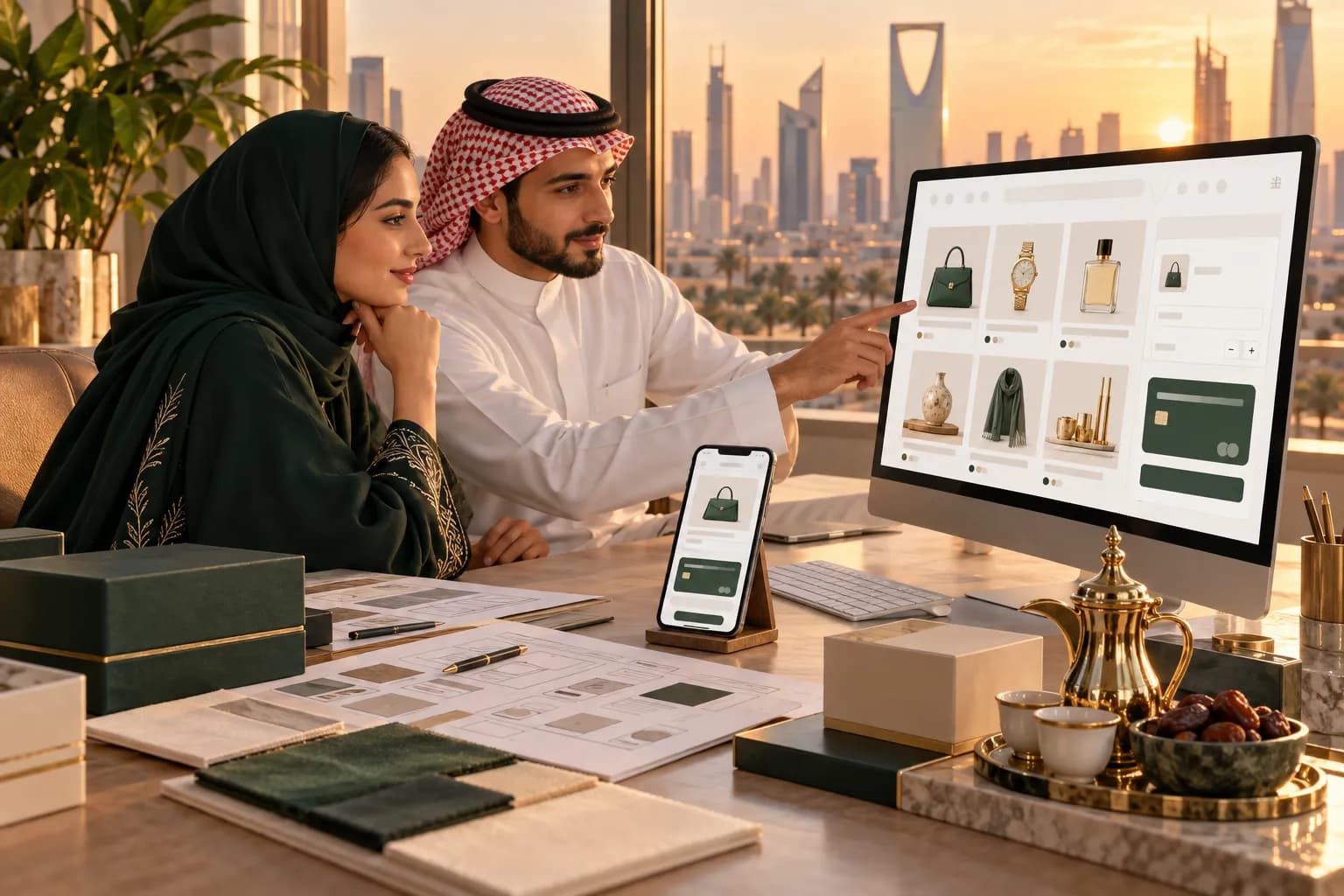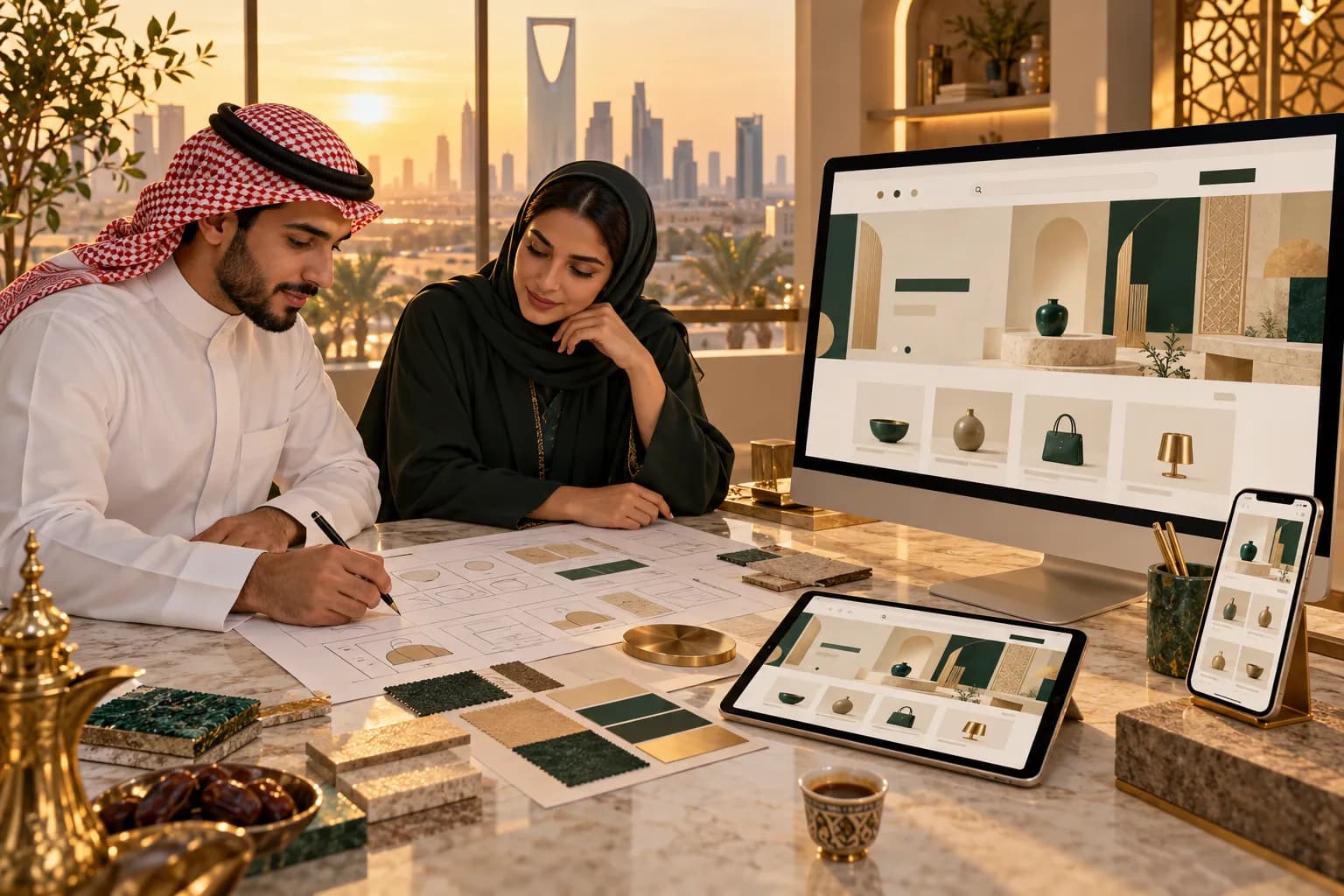
- One plan for the whole launch: market order, entity route, sales channels, payments, logistics, compliance and Arabic.
- Default route: launch from Dubai, then add a Riyadh warehouse once Saudi Arabia brings in about 30% of orders.
- Many brands start without a Gulf company, through marketplace programmes, DDP parcels from their own store or an importer of record.
- Product certificates come first: SABER for Saudi Arabia, ECAS for the UAE, and SFDA for cosmetics, food and supplements.
- You keep every account, contract and login in your own name. We run the plan and hand it over.
The Gulf is one of the most exciting ecommerce markets you can enter right now. Shoppers are young, mobile-first and well paid, and they already pay digitally.
The hard part isn't demand. It's the sequence: which country first, which licence, which channel, which certificates, and in what order.
That's what we do. We plan and run your market entry for Saudi Arabia and the UAE, from first call to first orders.
Who is this service for?
It's for brands that want to sell in the Gulf and would rather have one team run the launch than juggle ten providers. You bring the products. We build the route and run it with you.
It suits four kinds of seller:
- International DTC brands. You sell well in the US, Europe or the UK and want Saudi and Emirati shoppers next.
- Marketplace sellers going regional. You sell on Amazon elsewhere and want Amazon.sa, Amazon.ae and noon set up properly.
- Manufacturers and Chinese brands. You have the product and the price, and want a compliant route into the Kingdom.
- Regional brands crossing borders. You sell in one Gulf country and want the next one without repeating the guesswork.
The outcome? A live Gulf business with the right licences, certified products, local payments and a delivery setup that fits your volume.
Why does the Gulf reward a planned entry?
The Gulf rewards brands that get the order of steps right. Each country licenses, taxes and certifies separately, and one missing step can hold stock at the border.
Three local details shape every plan we build:
- Products need certificates before they ship. Most regulated goods entering Saudi Arabia need a SABER certificate, and the UAE runs its own ECAS scheme. Cosmetics, food and supplements also go through the SFDA in Saudi Arabia.
- Payments work differently by country. Saudi shoppers look for mada, the national debit card. Domestic mada needs a Saudi company, so foreign brands start with marketplaces or card routes. See how foreign companies accept mada.
- Delivery speed decides conversion. Saudi shoppers expect next-day delivery in the big cities. Parcels from Dubai typically reach them in 2–5 days, while stock in Riyadh can arrive the same or next day.
Our default route: Dubai first, then Riyadh
For most brands, the best first step is a Dubai base serving both countries. Then Riyadh joins once Saudi demand proves itself.
Here's why:
- Dubai is quicker to set up. A free-zone ecommerce licence is fast to issue, English works for shopping and support, and VAT is 5%.
- One stock pool serves both markets. Dubai stock ships to UAE shoppers locally and into Saudi Arabia as duty-paid (DDP) courier parcels.
- Saudi Arabia is the bigger prize. So the plan watches your Saudi share from day one.
- The 30% rule tells you when to move. Once Saudi Arabia brings in about 30% of orders, a Riyadh warehouse pays for itself through faster delivery and fewer refused COD parcels.

That's a default, not a rule for everyone. If you already sell in Arabic and your category is Saudi-led, we may plan a Saudi-first launch instead.
Comparing the two markets? Our UAE vs Saudi Arabia guide breaks down size, spend, tax and setup side by side.
What's included in GCC market entry?
Every project covers eight areas. We scope each one to your products and markets, so you only pay for the parts you need.
1. Market and country choice
We look at your category, price point and language, then recommend the order you enter. Saudi Arabia and the UAE usually come first. Kuwait, Qatar, Bahrain and Oman often follow from the same Dubai stock.
You get a written market order with the reasoning, so your board or investors can see why. Our Saudi Arabia and UAE market guides cover each country in depth.
2. Entity and licence route
You may not need a Gulf company on day one. We compare the routes and pick the lightest one that fits your plan:
| Marketplace cross-border | Own store, DDP parcels | Importer of record | UAE free-zone licence | Saudi company (MISA + CR) | |
|---|---|---|---|---|---|
| Gulf company needed | |||||
| Stock held in Saudi Arabia | Only via an IOR | Optional, via an IOR | |||
| Saudi VAT registration | When stock sits in KSA | Usually not: import VAT paid per parcel | Within 30 days of first sale | When stock sits in KSA | |
| Domestic mada in your own checkout | |||||
| Best for | Testing demand | Testing your own store | Stocking Saudi warehouses without an entity | A Dubai hub for the region | Scaling in Saudi Arabia |
A Saudi company starts with MISA investment registration, then a commercial registration (CR). Selling goods counts as trading, so 100% foreign ownership needs SAR 30 million in capital.
A local distributor is another legal route, but it owns the customer and the margin. Our guide to selling in the GCC as a foreign company compares every option.
3. Marketplaces vs your own store
We plan both channels and how they work together:
- Marketplaces. Amazon.sa, Amazon.ae and noon, with the right seller programme, fulfilment option and Arabic listings.
- Your own store. Shopify, Salla or Zid, set up for local currencies, VAT-inclusive prices and Arabic.
- The split. Which products go where, so channels don't compete on price.
Not sure which marketplace fits? Our Amazon vs noon comparison helps.
4. Payments and payouts
We map how each shopper pays and how the money reaches you:
- Local methods such as mada, Apple Pay, cards and BNPL like Tabby and Tamara.
- Cash on delivery, with a policy and verification steps that keep refusals down.
- The right gateway for your entity route, or a marketplace or merchant-of-record setup if you have no local company yet.
- Payouts to your bank account in your home currency or in dollars.
See our GCC payment methods guide for the full list.
5. Logistics and fulfilment
We plan how stock gets in and how parcels get out:
- Inbound freight from your factory or warehouse, with a customs broker or importer of record.
- Fulfilment through marketplace warehouses, a Dubai 3PL or a Saudi 3PL.
- Last-mile couriers chosen city by city, with COD and returns handled.
For the route itself, see shipping from Dubai to Saudi Arabia.
6. Product compliance: SABER, ECAS and SFDA
We check every product early and line up the paperwork:
- SABER (Saudi Arabia). A product certificate for each regulated item, then a shipment certificate before each consignment. See our SABER certificate guide.
- ECAS (UAE). A UAE certificate of conformity for regulated goods such as electricals, toys and cosmetics. See ECAS product conformity.
- SFDA (Saudi Arabia). Cosmetics, food and supplements, each with its own system. See SFDA for cosmetics and food.
- Labels. Arabic labelling and the details each country requires on pack.
7. Tax and Arabic
Two things every Gulf launch needs, whatever the route:
- VAT registration where you hold stock: 15% in Saudi Arabia and 5% in the UAE. Foreign sellers get no Saudi threshold, so once stock sits in the Kingdom you register with ZATCA within 30 days of the first sale. DDP courier parcels from Dubai pay import VAT at the border instead, so they usually don't trigger Saudi registration.
- Arabic content for listings, your store, packaging inserts and customer service, written for Gulf shoppers.
Our Saudi VAT for non-residents guide explains the rule.
8. Launch and first 90 days
We plan the launch around the Gulf calendar, such as Ramadan, White Friday and Saudi National Day. Then we track the numbers that matter early: conversion, delivery success, refusals and your Saudi order share.
How does a market entry project work?
Five steps, from first call to a live Gulf business. How long each step takes depends on your products, your certificates and your entity route.
- 1
Discovery
A call about your products, your current sales and your goals for the Gulf. We check which items need certificates and which markets fit first.
- 2
Plan
A written entry plan: market order, entity route, channels, payments, logistics, compliance and Arabic, with a written quote. Nothing starts until you approve it.
- 3
Build
We prepare licence and certificate files, set up marketplace accounts and your store, line up payments, freight and fulfilment, and get Arabic content ready. You sign and own every account.
- 4
Launch
Stock lands, listings and your store go live, and we place test orders with each payment method. We fix the blockers with you before you scale ads.
- 5
Support
We track your first months of orders, watch your Saudi share against the Riyadh trigger and plan the next market with you.
What you get at handover
When you're live, you'll have:
- A live Gulf setup, with licences, accounts and contracts in your company's name.
- A compliance file listing every product, its certificates and renewal dates.
- A provider map of who handles freight, customs, fulfilment, couriers and payments, with contacts.
- A launch dashboard showing the numbers to watch, with next-step ideas for growth.
Need specific providers instead of a full project? Our free quotes service matches you with 2–3 vetted providers for freight, 3PL, company setup and more.
What will you need to provide?
We run the plan. A few things only you can supply:
- Your product list, with materials, specs, HS codes if you have them and any test reports or certificates.
- Company documents, such as your trade licence, articles and passport copies for the owners.
- Current sales data, so the plan starts from what already sells.
- Your target markets and goals, including any dates you want to launch around.
- Budget for third-party fees, such as licences, certificates, freight and stock. These are paid directly by you.
- One decision-maker who can sign documents and approve choices quickly.
Selling from China? Bring your factory test reports to the discovery call. They often cut certificate work for Saudi Arabia.
Is this service right for you?
Tick the boxes that describe you. If most of them fit, a done-for-you market entry is likely a good match.
If you're testing a few products on one marketplace, you may not need a full project yet. Our guide to selling online in the Middle East shows the self-serve route, and we'll tell you honestly on the call.
Start your market entry plan
Tell us about your products, where you sell today and which Gulf markets you want. We'll get back to you to set up a short discovery call.
Prefer to compare options first? Browse all our services for Gulf sellers.
Frequently asked questions
It depends on scope: how many markets, how many products need certificates, and whether you want marketplaces, your own store or both. After the discovery call we send a written quote broken down by deliverable. Government, licence and certificate fees are paid directly by you, so you see exactly what goes where.
Sources & further reading
- Amazon Global Selling: Middle East — Amazon
- Saudi Arabia's population grows to 35.3M in 2024 (GASTAT) — Argaam
- E-payments reach 85% of retail payments in 2025 — Saudi Central Bank (SAMA)
- SABER platform: fees, validity and announcements — Saudi Standards, Metrology and Quality Organization (SASO)
- Issue Conformity Certificates for Regulated Products (ECAS) — UAE Ministry of Industry and Advanced Technology (MoIAT)
- Investor Guide (13th edition, March 2026) — Ministry of Investment (MISA)
- Use mada bank cards for buying products through the internet — SAMA Rulebook
- Saudi delivery sector tops 124M orders in Q4 2025 (TGA) — Mubasher / Transport General Authority (TGA)
This guide is for general information only and is not legal, tax or financial advice. Rules and fees change — always confirm with the official source or a licensed advisor.

Maya is MiddleEastEcom's lead guide and editor. She researches GCC marketplaces, payments and regulations and turns them into practical playbooks for sellers.
Meet Maya