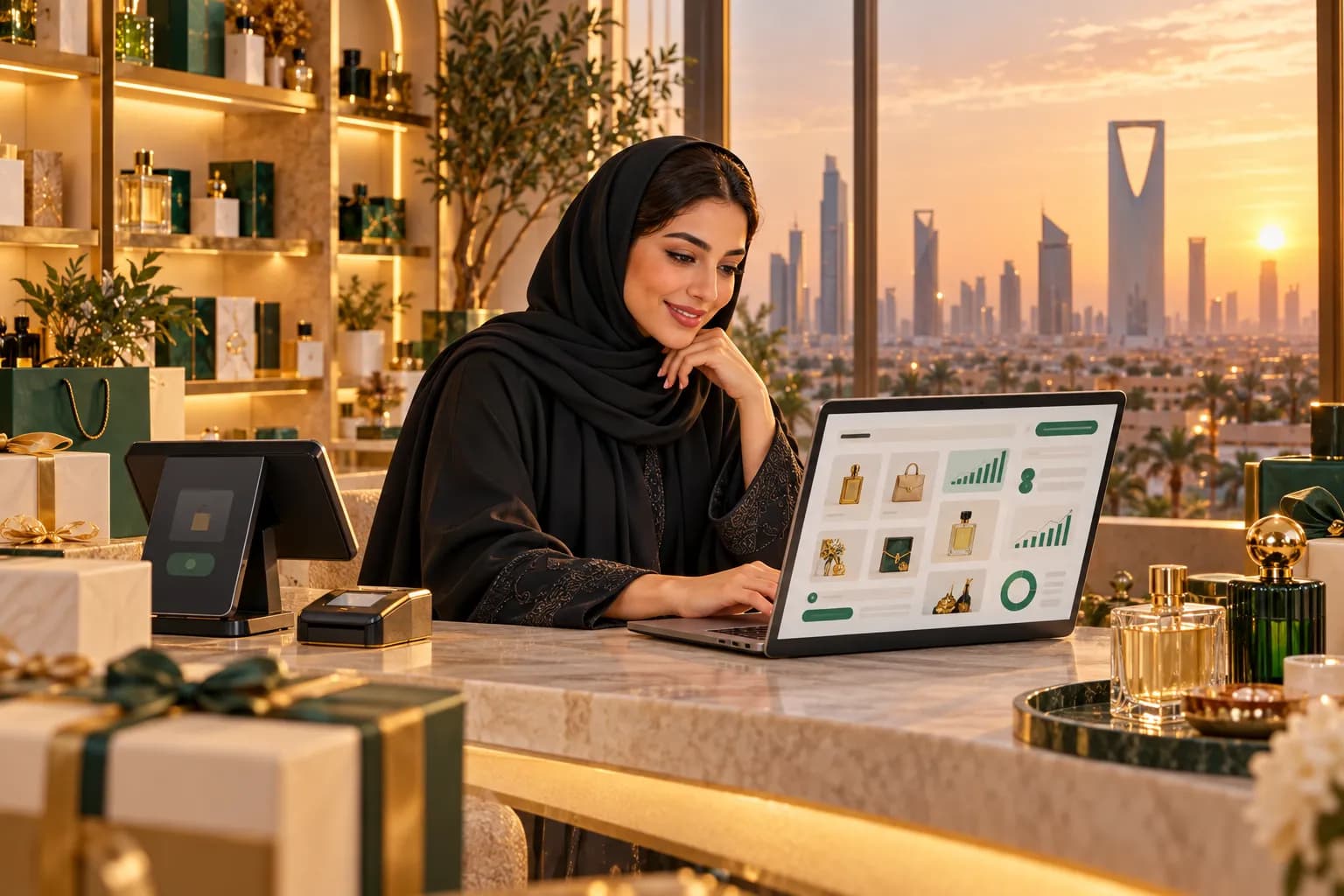

- Shopify is fully supported in all six GCC countries. Saudi stores pay $19 a month for Basic on annual billing, UAE stores $24.
- Shopify Payments is available only in the UAE. Everywhere else you use a local gateway, and Shopify adds 2% (Basic) down to 0.2% (Plus) on those orders.
- Cash on delivery carries no Shopify transaction fee, which matters for new brands in the Gulf.
- Since October 2026, Shopify's checkout displays right to left. You still translate the checkout text into Arabic yourself.
- Shopify is the best fit for multi-country brands and UAE companies. For a Saudi-only first store, Salla or Zid is usually cheaper.
Yes, Shopify works in the Middle East. Tens of thousands of Gulf brands already run on it, from Dubai perfume houses to Riyadh fashion labels.
And it's cheaper here than you might think. Shopify sets prices by region, so Saudi and UAE stores pay less than US stores for the same plan.
There's one big difference from selling in the US or UK. Shopify's built-in checkout, Shopify Payments, only works in the UAE.
You'll learn what Shopify costs across the Gulf, how you get paid, what Arabic takes and whether it beats the local platforms for you.
Does Shopify work in the Middle East?
Yes. Shopify is fully supported in Saudi Arabia, the UAE, Qatar, Kuwait, Bahrain and Oman. You can register your store in any of them, price in the local currency and ship anywhere in the region.
The Gulf rewards brands that show up properly. Shoppers are young, wealthy and live on their phones. They find brands on Snapchat, TikTok and Instagram, then buy in a few taps.
Shopify gives you the tools to reach them, plus a global app store and the best multi-country features of any platform.
Four things work differently here:
- Payments. Shopify Payments is UAE-only, so other stores plug in a local gateway.
- An extra fee. Shopify charges a small transaction fee on orders paid through outside gateways.
- Arabic. You need a right-to-left (RTL) theme and an Arabic translation.
- Local apps. Cash on delivery, couriers and Saudi e-invoicing come from apps, not Shopify itself.
Each one is a setup task, not a blocker. Most stores sort all four in a couple of weeks.
How much does Shopify cost in the Gulf?
Shopify bills in US dollars but charges by the country your store is registered in. Saudi stores get the lowest prices in the region.
| Basic | Grow | Advanced | Plus | |
|---|---|---|---|---|
| Saudi Arabia, annual billing | $19 | $54 | $299 | From $2,300 |
| Saudi Arabia, monthly billing | $27 | $72 | $399 | $2,500 (1-year term) |
| UAE, annual billing | $24 | $69 | $299 | From $2,300 |
| UAE, monthly billing | $32 | $92 | $399 | $2,500 (1-year term) |
| Fee on outside-gateway orders | 2% | 1% | 0.6% | 0.2% |
| Staff accounts | None | 5 | 15 | Unlimited |
For comparison, a US store pays $29 for Basic and $79 for Grow on annual billing. So a Saudi store saves about a third on Basic.
For most new stores, the choice is Basic or Grow. Your payment method decides it more than the plan price does, as the next section shows.
Budget for a few extras too: a paid RTL theme if you want one ($150–$420 one-off) and apps, often free to start. The full plan-by-plan breakdown is in our guide to Shopify pricing in the UAE and Saudi Arabia.
How you get paid: Shopify Payments vs local gateways
Shopify Payments works in 41 countries. In the Gulf, the UAE is the only one on the list.
That splits the region in two:
| UAE company | Saudi, Qatari, Kuwaiti, Bahraini or Omani company | |
|---|---|---|
| Card checkout | Shopify Payments, from 2.9% + AED 1 | A local gateway such as Tap, HyperPay or Geidea |
| Extra Shopify fee on cards | None | 2% to 0.2%, by plan |
| National debit cards (mada, KNET) | Not supported | Through the gateway |
| Charge shoppers in their own currency | Yes, via Shopify Markets | No, everyone pays in your store currency |
| Cash on delivery | Free of Shopify fees | Free of Shopify fees |
Running a local gateway is normal. Every serious Saudi Shopify store does it, and approval usually takes two to five business days.
What the extra fee really costs
The third-party transaction fee is Shopify's cut on top of your gateway's own fee. It applies to card and buy-now-pay-later orders, but not to cash on delivery.
For example, imagine a store taking 50,000 a month in card payments, in riyals or dirhams:
On a Saudi store, moving from Basic to Grow halves that fee. Grow costs $35 a month more on annual billing, about SAR 131. So it pays for itself once you pass roughly SAR 13,000 a month in gateway sales.
The UAE line is zero because Shopify Payments has no extra fee. You still pay its card rate, but you skip Shopify's surcharge. Tabby and Tamara orders still carry it, though, even in the UAE.
Which gateway should you pick? Our Saudi Shopify gateway comparison ranks the options by mada rate, Apple Pay support and payout speed.
Arabic and right-to-left on Shopify
Shopify handles Arabic storefronts well. You need two things: a theme that mirrors right to left, and a proper translation.
Here's the good news for 2026. Since October 2026, Shopify's admin, checkout, customer accounts and its free Horizon themes all display right to left.
Here's the catch. Arabic still isn't one of the 33 checkout languages Shopify translates for you.
So you translate the checkout text and order emails yourself. If you skip it, Arabic shoppers hit an English checkout at the final step.
The rest is straightforward:
- Pick an RTL-ready theme. Test a Horizon theme, or choose one of the 24 paid themes tagged right-to-left.
- Add Arabic in Settings > Languages. Shopify's free Translate & Adapt app machine-translates up to two languages.
- Have a native speaker edit product titles, menus and banners.
- Use subfolders like /ar-sa and /en-ae, so every language builds SEO on one domain.

The step-by-step setup is in our Arabic Shopify store guide.
The apps every Gulf store needs
Shopify's core doesn't know about mada, COD refusals or Saudi e-invoicing. Apps fill the gaps, and the Gulf stack is small and well tested.
| Need | What sellers use | Good to know |
|---|---|---|
| Cash on delivery with OTP | Releasit COD Form (4.9★, free up to 60 orders a month) | Verifies phone numbers by SMS or WhatsApp before you ship |
| Buy now, pay later | Tabby, Tamara, MISpay | Free apps; each provider charges per order |
| Saudi e-invoicing (ZATCA) | Marmin, Sufio or a Qoyod connector | Needed once you're VAT-registered in Saudi Arabia |
| Couriers | Aggregators such as OTO and Shipox | Official Aramex and SMSA apps rate 1.7 out of 5 |
| Translation | Translate & Adapt (free), Weglot, LangShop | Your theme still has to support RTL |
Two plan details matter here. Live courier rates at checkout need carrier-calculated shipping, which is included on Advanced and Plus and comes free with Grow on annual billing. On Basic, use flat rates and a free-shipping threshold.
And COD still matters. Sellers launching new brands report that COD can be 40–60% of their first orders, so set it up from day one. Our guide to the best Shopify COD apps compares the OTP options.
Is Shopify right for you, or Salla and Zid?
Salla and Zid are Saudi platforms built Arabic-first. They start at SAR 99 a month, take no commission and bundle mada, BNPL, COD, couriers and ZATCA invoicing.
Shopify is the global platform. It has 8,000+ apps, more design freedom and the strongest tools for selling in several countries.
So who should pick Shopify?
- UAE companies. Shopify Payments removes the extra fee, which makes Shopify very competitive.
- Brands selling in several countries, across the Gulf or beyond, from one store.
- Global brands already running Shopify at home.
- Saudi brands planning to expand in the next year or two.
Pick Salla or Zid if you sell only in Saudi Arabia, want everything in Arabic and want the lowest running cost.
Not sure yet? Answer a few questions and the picker suggests a platform.
Which platform should you sell on?
7 quick questions. We score Shopify, Salla, Zid, WooCommerce, Amazon and noon for your situation.
Question 1 of 7
Where is your business based?
Where your company or trade licence is registered.
Scores are an editorial estimate based on published pricing and features as of October 2026 (noon details partly unverified); confirm with each provider before committing.
The full cost and feature breakdown is in our Shopify vs Salla vs Zid comparison.
How to launch a Shopify store in the Gulf
Start the slow steps, like gateway approval and translation, on day one. Most small stores go live in two to four weeks.
- 1
Register under your local company
Sign up with your Saudi, UAE or other GCC business so you get regional pricing. Set the store currency to SAR, AED or your local currency.
- 2
Choose Basic or Grow
Start on Basic, then move to Grow once your gateway sales pass the break-even above. UAE stores on Shopify Payments can stay on Basic longer.
- 3
Turn on payments
UAE companies activate Shopify Payments. Everyone else applies to a local gateway with mada or KNET, then adds Tabby or Tamara and cash on delivery.
- 4
Make it Arabic
Pick an RTL-ready theme, add Arabic, translate the checkout and have a native speaker review it.
- 5
Add your local apps
Install a COD form with OTP, a courier or aggregator app and, in Saudi Arabia, a ZATCA invoicing app.
- 6
Test every payment method
Place test orders with cards, Apple Pay, BNPL and COD in both languages, plus one refund.
Our Shopify GCC setup guide walks through each setting.
Notes for Saudi sellers
- Your plan is the cheapest in the region, but you'll pay the extra fee on every card and BNPL order. Plan for Grow early.
- Show mada at checkout. Saudi shoppers look for it, and it's the cheapest card for you to accept.
- Get your CR first. Gateways and couriers ask for it before they activate your account.
- E-invoicing has a deadline. Most VAT-registered stores must be fully connected to ZATCA by February 2027. See Shopify in Saudi Arabia for the full setup.
Notes for UAE companies
- You qualify for Shopify Payments with a mainland or free zone trade licence and an AED bank account whose IBAN starts with "AE".
- You can charge Saudi and Kuwaiti shoppers in their own currency through Shopify Markets, with a 2% conversion fee.
- Shopify Payments doesn't take mada, so Saudi debit cards go through as Visa or Mastercard. Our Shopify UAE guide covers requirements and payouts.
Notes for Kuwait, Qatar, Bahrain and Oman
- No Shopify Payments yet, so the setup looks like Saudi Arabia: a regional gateway plus Shopify's extra fee.
- Ask for local debit cards by name. KNET, QPay, Benefit and OmanNet aren't on by default with most gateways.
- KNET matters most. Payment providers put its share of Kuwait's online payments at 75–80%.
Notes for larger brands
- Shopify Plus starts at $2,300 a month on a three-year term and cuts the extra fee to 0.2%.
- Expansion stores let you run a UAE store on Shopify Payments and a Saudi store on a local gateway, each in its own currency.
- Read Shopify Plus in the GCC before you sign a long contract.
Go deeper
Where things stand and what to use instead.
Currencies, domains and languages for multi-country stores.
RTL-ready themes worth testing.
Products, redirects and a launch checklist.
More platform guides live in our ecommerce platforms hub.
Frequently asked questions
Yes. Shopify doesn't ask where you live, and many foreign brands sell to Gulf shoppers from a store registered at home. What changes is payments: local methods such as mada and KNET usually need a local company, so foreign stores start with Visa, Mastercard and Apple Pay through a global gateway.
Sources & further reading
- Shopify pricing (Saudi Arabia) — Shopify
- Shopify pricing (UAE) — Shopify
- Shopify Payments supported countries — Shopify Help Center
- Requirements for selling in multiple languages — Shopify Help Center
- Admin now available in 3 new languages (RTL update) — Shopify Changelog
- Third-party carrier-calculated shipping — Shopify Help Center
- Managing VAT for Shopify billing in Saudi Arabia and the UAE — Shopify Help Center
- Shopify stores in Saudi Arabia — Store Leads
This guide is for general information only and is not legal, tax or financial advice. Rules and fees change — always confirm with the official source or a licensed advisor.

Maya is MiddleEastEcom's lead guide and editor. She researches GCC marketplaces, payments and regulations and turns them into practical playbooks for sellers.
Meet Maya