
- Google handles about 94% of searches in Saudi Arabia, so SEO here is Google SEO. Bing and Yandex aren't worth separate work.
- Only about 0.6% of websites are in Arabic. Many Arabic shopping searches have weak results you can beat.
- Research Saudi terms, not translations. Saudis search جوال for a phone, شنطة for a bag and كود خصم for a discount code.
- Give each language its own URL (/ar-sa/, /en-sa/), link them with valid hreflang codes and never force IP redirects.
- Plan content around Ramadan, White Friday and National Day. Ramadan 2027 starts around 8 February.
Ecommerce SEO in Saudi Arabia is mostly a race to be the best Arabic answer on Google. And right now, that race is wide open.
Google handles almost every search in the Kingdom, yet only a tiny slice of the web is written in Arabic.
That means a store with real Arabic category pages, the words Saudis actually type and fast mobile pages can outrank brands ten times its size.
You'll learn how Saudis search, how to research Arabic keywords with dialect data, how to set up a bilingual store, and what to publish before Ramadan and White Friday. It's part of our SEO guides for Gulf stores.
Why is SEO such a big opportunity in Saudi Arabia?
Because demand is huge and good Arabic supply is thin. Saudi shoppers search a lot, and they search in Arabic, but many results for shopping terms are weak.
Here's what works in your favour:
- One search engine to win. Google handles nearly all Saudi searches, and Bing and Yandex split the small remainder, so one strategy covers almost everyone.
- Little Arabic competition. Many Arabic shopping searches return thin category pages, marketplace listings and clumsy machine translations. A well-built Arabic page stands out fast.
- Shoppers prefer their own language. Saudi Arabia is an Arabic-first market, but English still matters for brand and model searches, so you'll want both.
- Organic traffic compounds. Snapchat and Google Ads stop when your budget does. A category page that ranks for شنط نسائية keeps selling every night.
- Google is filling the gap for you, badly. Since early 2025, Google often shows auto-translated copies of English pages in Arabic results. Your English page can appear, but through Google's proxy, with a translation you didn't write.
That last point is the real "why now". Machine translations are filling Arabic results today, and native Arabic pages are how you take that traffic back.
New to the market itself? Our Saudi Arabia ecommerce guide covers who buys, how they pay and how to get set up.
How do Saudis search? Arabic keyword research that works
Saudis don't search the way a translation tool writes. They mix Modern Standard Arabic (MSA, the formal written language) with Saudi dialect, English loanwords in Arabic script and plain English.
So the first rule is simple: don't translate your English keyword list. Research Arabic terms from scratch, for each country you sell in.
Dialect decides the winning word
We pulled a year of Google Trends data for common product terms in late October 2026. The scores show relative interest, where 100 is the most-searched term in that comparison, so compare words within one country, not across countries.
The Saudi word جوال wins by a mile. In Egypt, the same chart flips: موبايل scores 84 and جوال just 4. A store that copies Egyptian Arabic content would miss most Saudi phone searches.
It's the same story across categories:
| Product | Terms compared | Saudi Arabia | What to do |
|---|---|---|---|
| Mobile phone | جوال / موبايل / هاتف | 82 / 16 / 25 | Use جوال in titles for Saudi pages |
| Bag | شنطة / حقيبة / شنط | 54 / 12 / 46 | Colloquial شنطة in the title, MSA حقيبة in body copy |
| Shoes | جزمة / حذاء / جوتي | 31 / 58 / 4 | حذاء leads, جزمة is a strong second |
| Slippers/sandals | نعال / شبشب | 39 / 42 | Near tie, so cover both |
| Air conditioner | مكيف / تكييف | 52 / 4 | Use مكيف |
| iPhone | ايفون / آيفون / iphone | 37 / 2 / 38 | Arabic and Latin script split evenly |
| Discount code | كود خصم / كوبون / رمز خصم | 71 / 17 / 1 | Use كود خصم, never رمز خصم |
Two patterns jump out. Saudis type informally, so the hamza-free ايفون crushes آيفون. And everyday words often beat formal MSA, like شنطة over حقيبة.
Spelling variants to check
Saudi shoppers type fast on their phones, so check these variants for every head term:
- Hamza: اسعار vs أسعار.
- Taa marbuta: عباية vs عبايه.
- Alef maqsura: ى vs ي.
- Singular, plural and "al-": عطر رجالي vs عطور رجالية vs العطور الرجالية.
- English in Arabic script: لابتوب, سيروم, بلوتوث. These are often the head terms.
Pick the most-searched form for your title and H1. Use the others naturally in body text, FAQs and image alt text, but never stuff them in.
A simple research process
- 1
Brainstorm in Arabic, not from English
Ask a Saudi native speaker how they would search for each product. Write down every word they use, including dialect and English-in-Arabic forms.
- 2
Pick variants with Google Trends
Set the country to Saudi Arabia and compare up to five variants. Keep the winner as your main term and the runners-up as secondary terms.
- 3
Pull volumes per country
In Keyword Planner, set the location to Saudi Arabia and the language to Arabic, then repeat in English. In Ahrefs or Semrush, use the SA database.
- 4
Mine marketplaces and autocomplete
Type your product into Amazon.sa, noon and google.com.sa in Arabic. The suggestions show the exact nouns buyers use.
- 5
Map one cluster to one URL
Group all variants of one idea onto one page. Record it in a bilingual keyword map: EN keyword, AR keyword, intent, URL.
- 6
Check the Arabic results page
Look at what ranks. Arabic shopping results are often category pages with filters, prices and reviews, so build that, not a blog post.
Expect small numbers. Arabic volumes look tiny next to English ones, and tools are least accurate for dialect words.
That's fine, because a few hundred buyers a month for شنط نسائية جلد is real money.
Want the full method, with Arabizi and Gulf-wide differences? Read our guide to Arabic keyword research.
How should you structure a bilingual Saudi store?
Give every language its own URL on one domain, which for most stores means subfolders like /ar-sa/ and /en-sa/.
Google reads the visible text to decide a page's language, so a page must really be in Arabic to rank in Arabic.
| Subfolders | ccTLD (.sa) | Subdomains | ?lang= parameter | Same URL, IP/cookie switching | |
|---|---|---|---|---|---|
| Example | store.com/ar-sa/ | store.sa | ar.store.com | store.com?lang=ar | store.com |
| Shares domain authority | Partly | ||||
| Local signal | Via hreflang | Strongest | Via hreflang | Weak | None |
| Cost and effort | Low | High | Medium | Low | Low |
| Google indexes Arabic reliably | Risky | ||||
| Verdict | Best default | Big brands only | Works, no advantage | Avoid | Avoid |
Why avoid IP switching? Googlebot crawls mostly from the US, without a language preference. If your site picks the language by IP or cookie, Google may never see your Arabic pages at all.
When to split Saudi and UAE versions
Use plain /ar/ and /en/ if price, currency and delivery are the same everywhere. Split into /ar-sa/ and /ar-ae/ when they differ.
For most Gulf stores they do differ: Saudi prices are in SAR with 15% VAT, while UAE prices are in AED with 5% VAT.
Hreflang, done right
Hreflang tags tell Google which version to show to which shopper. Each page lists itself and every alternate, and the links must go both ways.
Here's a correct set for one product sold in Saudi Arabia and the UAE:
| hreflang | URL |
|---|---|
ar-SA | example.com/ar-sa/products/oud-perfume |
en-SA | example.com/en-sa/products/oud-perfume |
ar-AE | example.com/ar-ae/products/oud-perfume |
en-AE | example.com/en-ae/products/oud-perfume |
ar (fallback for other Arab countries) | example.com/ar-sa/products/oud-perfume |
x-default | example.com/products/oud-perfume |
Each pair goes in the page head as a link rel="alternate" tag, with full https URLs. The same set appears on every version of the page.
URL slugs can be Arabic or English. Arabic slugs carry keywords but turn into long %D8%B9… strings when shared, which is why many Gulf stores keep English slugs on Arabic pages. Pick one convention and stick to it.
Need every rule in one place? See our hreflang guide for GCC stores.
How do you write Arabic product and category pages that rank?
Write them in Arabic from the start, for a Saudi buyer. Translated English pages read stiffly, miss the real search terms and convert worse.
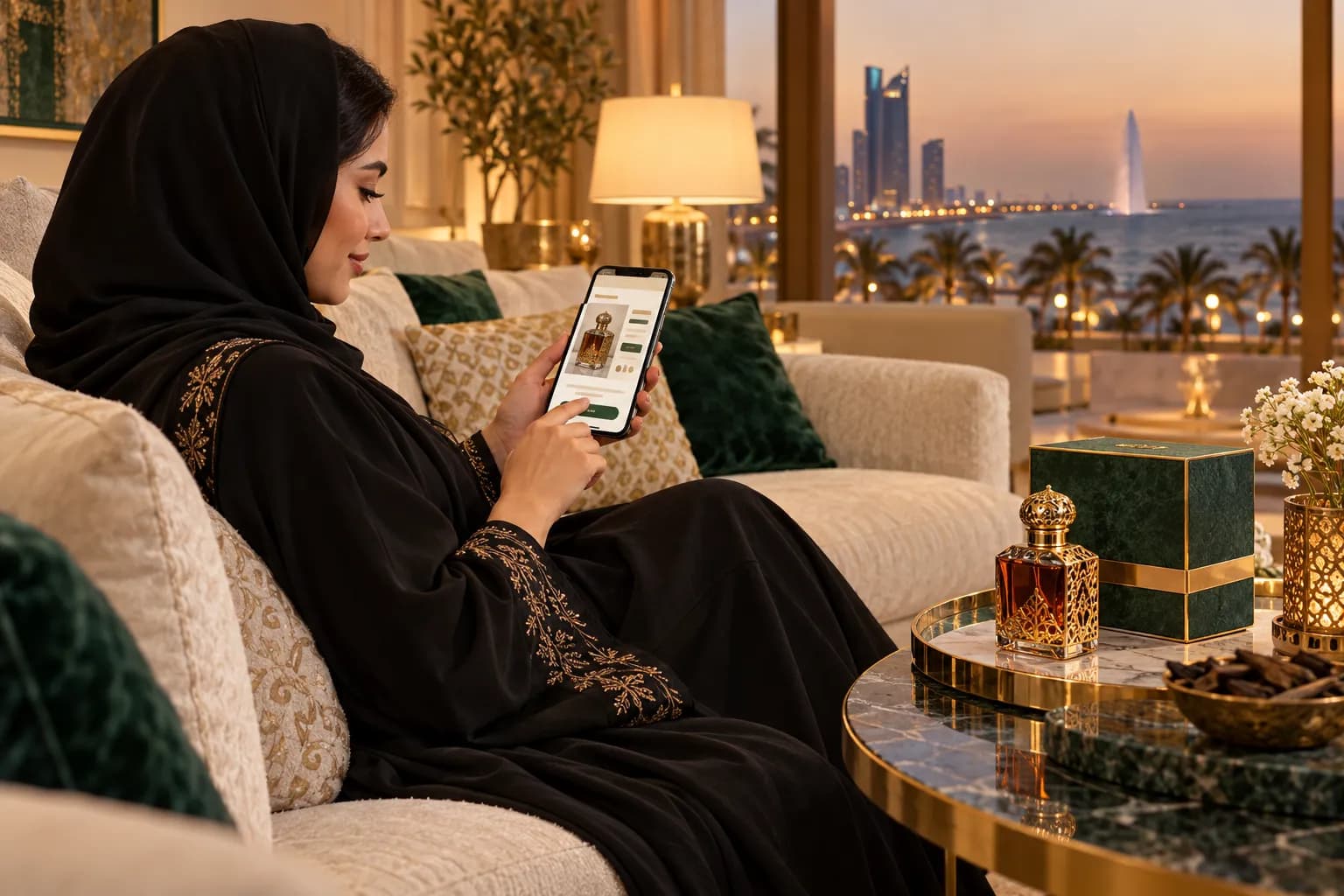
Category pages carry most of the weight
Arabic shopping searches usually land on category results, so your collection pages are your main SEO asset.
Give each one:
- An Arabic H1 with the head term, such as عطور رجالية or شنط نسائية.
- A short intro of 50–120 words above or below the grid, in natural MSA.
- Filters for size, colour and price that don't create thousands of indexable URLs.
- Prices in SAR, VAT included, plus ratings on each product card.
- Links to sub-categories with descriptive Arabic anchors.
The Saudi product page formula
The title does the heavy lifting. Use this order: product noun shoppers search, brand, key attribute, size or variant.
For example: عطر عود رجالي فاخر 100 مل – ثبات يدوم طويلاً. It opens with the searched noun (عطر عود), not a marketing name.
Then match each part of the page to the right register:
| Page element | Register | Example |
|---|---|---|
| Title, specs, size guide, policies | Clear, simple MSA | عطر عود رجالي 100 مل |
| Description body | Light, modern MSA | Short benefit-first sentences |
| Headlines, banners, CTAs | Light Saudi dialect | اطلبه الحين |
| Ads and social | Full dialect | Snapchat and TikTok scripts |
Under the title, use 4–6 benefit-first bullets, a specs table, what's in the box and a short Arabic FAQ. Add the delivery promise by city and the payment options, like mada, Tabby and cash on delivery.
Metadata and schema
Write a unique Arabic meta title and description for every product and category. Arabic text is often a little shorter in characters at the same pixel width, so check it in a SERP preview.
Add Product schema to every language version. The Arabic page needs the Arabic name and description in its JSON-LD, with priceCurrency set to SAR.
For a full template, see our guide to Arabic product descriptions.
Technical SEO basics for Saudi stores
Most Saudi shopping happens on phones, so technical SEO here starts with mobile speed. The good news? Saudi networks are fast, so slow stores are usually held back by heavy themes, apps and fonts.
Work through this list once at launch, then re-check every quarter:
Two items trip up Arabic stores more than any others.
The first is fonts. Heavy Arabic web fonts are a common cause of slow pages, so subset your WOFF2 files to Arabic and Latin characters and preload the body weight.
The second is digits. The browser's ar-SA format shows Eastern Arabic digits (١٬٢٣٤) by default. Saudi shoppers type Western digits into search and forms, so force them for prices and sizes with the locale tag ar-SA-u-nu-latn.
Layout mirroring, icons and font choices are covered in our RTL design guide.
Local trust signals that help SEO and sales
Google wants to rank stores people trust, and Saudi shoppers want the same thing before they pay. The signals overlap, so one round of work helps both.
Add these to your store:
- Saudi Business Center authentication. In March 2023, the Ministry of Commerce moved e-store authentication from Maroof to the Saudi Business Center's Business Platform. You need a CR or Freelance Document and a business bank account, then the badge goes in your footer.
- CR and VAT numbers. Put your commercial registration and VAT number in the footer, checkout and invoices.
- Arabic reviews with photos. Ask for a review on WhatsApp after delivery, and show the reviewer's city.
- A clear Arabic returns page. Say the window, who pays and how to start a return.
- Delivery promises by city. "Riyadh and Jeddah: 1–2 days" builds confidence and earns clicks.
- A local WhatsApp number. It's the default support channel in the Kingdom.
These also feed E-E-A-T, Google's checklist for experience, expertise, authority and trust. A real About page, named people and a physical address all count.
See the full list in our guide to trust signals for Gulf stores.
Content ideas around Ramadan, White Friday and National Day
Saudi shopping runs on a seasonal calendar. Searches for gifts, deals and outfits spike before each big event, so publish your pages weeks ahead, not on the day.
Here are the next windows to plan for:
- 11 Nov 202611.11 Singles' Day
Now a standard marketplace deal day in the Kingdom. A short landing page with your offers is enough.
- ~19–30 Nov 2026White Friday / Yellow Friday
The biggest Q4 event. Publish a permanent /white-friday/ page and update it each year, so it keeps its rankings.
- Mid-Jan 2027Pre-Ramadan content goes live
Gift guides, Ramadan outfits and home decor pages. Shoppers plan early and hold purchases for Ramadan deals.
- ~8 Feb – 8 Mar 2027Ramadan 1448
The most important season of the year. Shopping moves to late night, after taraweeh prayers.
- ~26 Feb – 8 Mar 2027Last 10 nights and Eid gifting
Peak for fragrance, oud, sweets, dates and kids' clothes. Show “order by” dates for delivery before Eid.
- 23 Sep 2027Saudi National Day (97th)
The second-biggest Saudi promo after White Friday. Green creative, codes using the number 97.
Ramadan is where content pays off most. In a 2025 survey, 76% of shoppers said they delay purchases to catch Ramadan promotions. And 89% buy Eid gifts for family.
Pages worth building before Ramadan:
- Gift guides in Arabic, like هدايا رمضان or هدايا العيد للرجال, linked to your categories.
- Seasonal category pages, such as عطور العيد or ملابس العيد للأطفال.
- A Ramadan offers page with your كود خصم, kept on the same URL every year.
- Delivery cut-off FAQs, like "order by X for delivery before Eid". Couriers slow down for 2–4 days around each Eid.
Ramadan moves about 11 days earlier each year, so check the dates every autumn. Our Ramadan ecommerce guide has the full playbook.
Notes for Shopify stores
Shopify handles a lot of international SEO for you, but Arabic needs a few extra steps:
- Use Shopify Markets with subfolders such as
/ar-sa/. Shopify then generates hreflang tags and sitemaps automatically, as long as you're on a custom domain. - Pick an RTL-ready theme. Shopify says its Horizon-family themes support RTL. Preview with Arabic published before you commit.
- Translate the checkout yourself. Arabic isn't one of Shopify's pre-translated checkout languages.
- Edit machine translations. Translate & Adapt drafts Arabic for free, but have a Saudi native rewrite titles, collections and meta fields.
- Turn off forced geo-redirect apps. Use a language banner instead.
Want us to set it up? See our Shopify SEO service for Saudi Arabia, or read Shopify Arabic SEO.
Notes for Salla and Zid stores
Salla and Zid are Arabic-first, so the RTL basics come built in. Your SEO work is mostly content and settings:
- Connect your own domain. It needs a paid plan: Salla Plus or Zid Rise, both SAR 99 a month.
- Fill in the SEO title and description for every product and category, in Arabic, using your keyword map.
- Write category intros. Platform defaults often leave collection pages with just a grid.
- Check what the platform outputs. Open the page source and look for the canonical, hreflang (if you run English too) and Product schema.
- Planning a move to Shopify later? Map every old URL to its new one and set 301 redirects before you switch.
Compare the platforms in Shopify vs Salla vs Zid.
Notes for bilingual stores
Running Arabic and English side by side? A few rules keep both versions strong:
- One language per URL. Don't put Arabic and English blocks on the same page.
- Full content parity. Translate specs, size guides, shipping and returns, not just titles. A thin Arabic page with English specs underperforms.
- Separate Merchant Center feeds for Arabic and English. The landing page language must match the feed.
- Split your effort by market. For Saudi Arabia, aim for about 70% Arabic and 30% English work. For the UAE, flip it to about 60% English.
- Measure per language. Filter Search Console by country and query language, and review it every three months.
The deeper guide is bilingual SEO for Gulf stores.
Notes for cross-border sellers
Selling into the Kingdom from abroad? SEO works the same way, with a few extra points:
- Start with your best sellers in Arabic. You don't need the whole catalogue on day one. Write native Arabic pages for your top categories and products first, then expand.
- Show Saudi prices and delivery. SAR prices with VAT and a clear delivery time to Saudi cities earn more clicks than USD prices.
- Borrow trust where you can. Without a Saudi registration, lean on Arabic reviews, marketplace ratings and clear returns.
- Use marketplaces for research. Arabic titles of top Amazon.sa and noon listings show you the exact words buyers use.
Ready to go further? Our Arabic SEO service builds the keyword map and Arabic pages for you.
Frequently asked questions
Yes, if you plan to sell for more than one season. Ads stop the day you stop paying. Arabic category and product pages keep bringing buyers in, and competition for many Arabic shopping terms is still light. Most stores run SEO alongside ads, not instead of them.
Sources & further reading
- Search engine market share, Saudi Arabia (Sep 2026) — StatCounter Global Stats
- Usage statistics of content languages for websites — W3Techs
- Tell Google about localized versions of your page — Google Search Central
- Managing multi-regional and multilingual sites — Google Search Central
- Google auto-translated pages in search results — Ahrefs
- Requirements for selling in multiple languages — Shopify Help Center
- Google Trends 12-month comparisons of Arabic product terms (pulled 26 Oct 2026) — Google Trends
- Ramadan and Eid 2025 consumer survey (Toluna & MatrixLab) — Arabad Digital
This guide is for general information only and is not legal, tax or financial advice. Rules and fees change — always confirm with the official source or a licensed advisor.

Maya is MiddleEastEcom's lead guide and editor. She researches GCC marketplaces, payments and regulations and turns them into practical playbooks for sellers.
Meet Maya