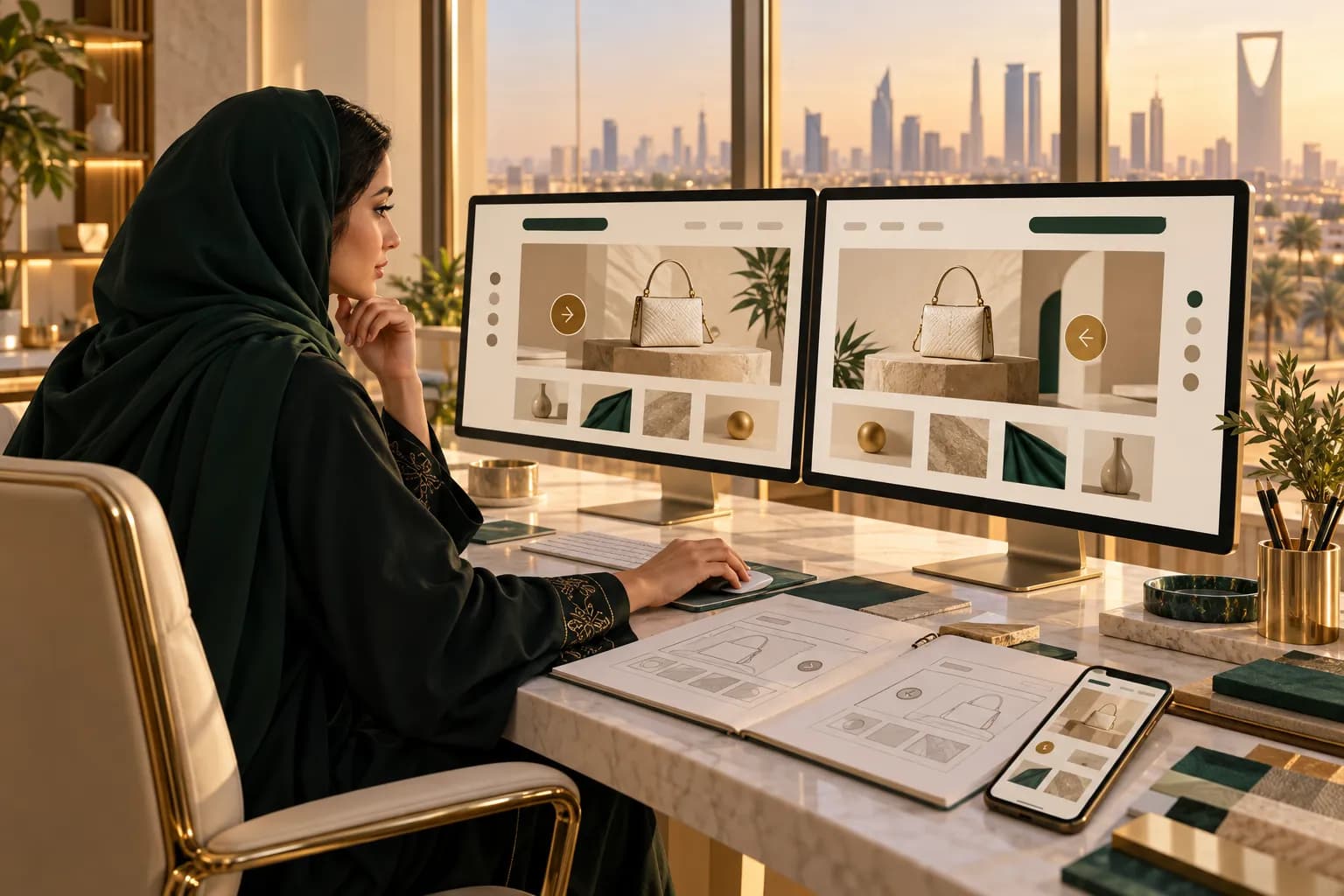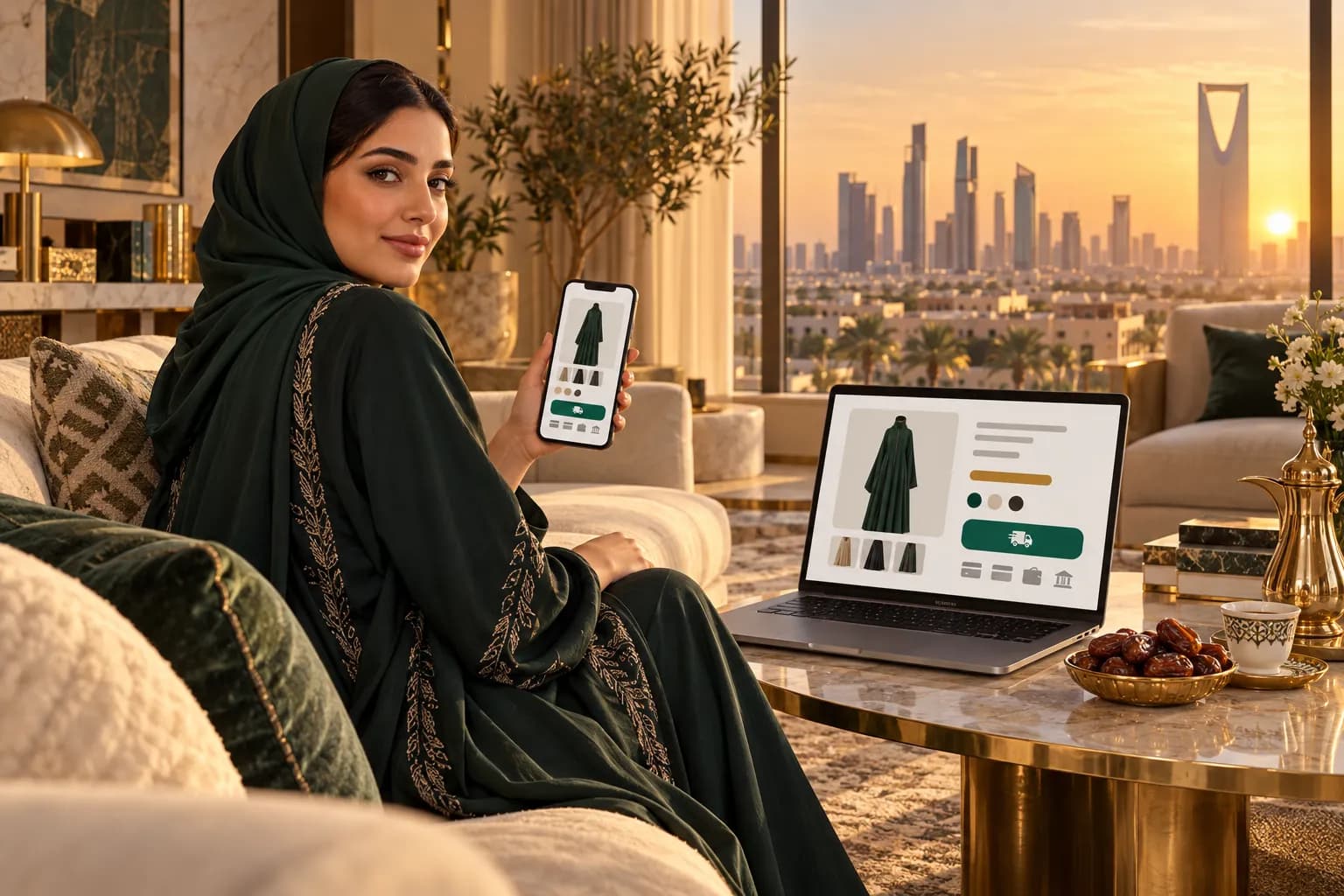

- Build the Arabic page first: variant names, specs, size guide and buttons, not just the description.
- Show one VAT-inclusive SAR price, with the riyal symbol on the left and a Tabby or Tamara split right below it.
- Promise a delivery date by city, and place mada, Apple Pay, BNPL and COD badges under the buy button.
- Sum up returns in one line. Saudi law gives shoppers 7 days to cancel, and many stores offer 14 or more.
- On a phone, price, delivery date and payment badges should all fit on the first screen.
Saudi shoppers buy fast when a product page answers their questions on the first screen.
How much is it, really? When will it arrive, and can I pay the way I like? Can I send it back if it doesn't fit?
Most foreign product pages answer none of that. They're in English, add tax at checkout and say "ships in 7–21 days".
Fix those gaps and you're ahead of most of your competition. Saudi Arabia is the Gulf's biggest ecommerce market, and its shoppers are young, mobile and happy to buy from new brands that feel local.
Below is every block a Saudi product page needs, where each one goes on a phone, a before-and-after example and a checklist. It's part of our GCC localization guides.
What makes a Saudi product page different?
A Saudi product page does the same job as anywhere else. It just has to win trust faster, because the shopper often doesn't know your brand yet.
Here's what Saudi shoppers look for, roughly in the order they scan:
- Arabic first. Title, specs and size guide in Arabic, with English as the second language.
- One honest price. Saudi riyals, VAT included, with an instalment line below it.
- A delivery date. "Riyadh: tomorrow" beats "3–5 business days".
- Familiar payment badges. Mada, Apple Pay, Tabby or Tamara, and cash on delivery.
- An easy way out. A one-line returns summary.
- A human to ask. A WhatsApp button with a Saudi number.
- Proof from people like them. Arabic reviews that show the reviewer's city.
- Respectful images. Modest styling that fits local norms.
- Proof you're a real business. Your commercial registration (CR) and VAT numbers in the footer.
Three of these are legal duties: the VAT-inclusive price, the cancellation terms and your business details. The rest are habits shoppers bring from noon, Amazon.sa and big local brands.
1. Arabic everywhere on the page, not just the description
Saudi Arabia is Arabic-first. Most online shoppers are Saudis, and they search and compare in Arabic.
So build the Arabic page as your main page, then add English. Four places often stay in English by accident:
- Variant names. Colours and sizes in Arabic (بيج رملي), not "Sand Beige / L".
- Specs. A short Arabic table rather than a paragraph, so shoppers can scan it.
- Size guide. A link right beside the size picker that opens an Arabic chart.
- Buttons and messages. "أضف إلى السلة", stock alerts, delivery notes and error messages.
Open your page in Arabic on a phone and look for any leftover English. Theme strings and apps are the usual culprits.
Writing the Arabic title and copy is its own skill. Our guide to Arabic product descriptions covers the title formula, tone, dialect and units.
2. A VAT-inclusive SAR price
The price on the page must be the price the shopper pays. Saudi consumer prices must include the 15% VAT, and the Ministry of Commerce treats a checkout total above the shelf price as a violation.
That means:
- Show the price in Saudi riyals, never in US dollars.
- Include VAT in the price, with a small "Prices include VAT" note.
- Put the riyal symbol to the left of the number, with a space, even on Arabic pages.
- Use Western digits (169, not ١٦٩), as most big Saudi stores do.
Then add the instalment line right under the price. "Or 4 payments of SAR 42.25 with Tabby" makes a bigger price feel easy.
Don't just multiply your dollar price by 3.75. Add the VAT, then round to a local price point.
For example, a USD 39.99 pre-tax price converts to SAR 149.96. With 15% VAT it's SAR 172.46.
Round it to SAR 169. The Tabby line then reads 4 payments of SAR 42.25.
GCC price localizer
Turn one base price into six shelf prices, with VAT, local rounding and Arabic display
Markup is applied, then local VAT is added on top.
Consumer prices in KSA and the UAE are expected to include VAT.
Optional % added to the net price per market (e.g. to cover duty, shipping or BNPL fees).
Prices ending in 9 (SAR 99, 149, 199; AED 49, 99) dominate on noon, Amazon.sa and Shein (observation). For 3-decimal currencies this gives x.x90 endings.
- SARSaudi Arabia1 USD = 3.7515%SAR 169.00incl. 22.04 VAT-2% vs exact169.00 ر.س
- AEDUAE1 USD = 3.67255%AED 159.00incl. 7.57 VAT+3.1% vs exact159.00 د.إ
- QARQatar1 USD = 3.64No VATQAR 149.00No VAT+2.4% vs exact149.00 ر.ق
- KWDKuwait1 USD = 0.31≈ approx.No VATKWD 12.390No VAT-0.1% vs exact12.390 د.ك
- BHDBahrain1 USD = 0.37610%BHD 16.490incl. 1.499 VAT-0.3% vs exact16.490 د.ب
- OMROman1 USD = 0.38455%OMR 16.190incl. 0.771 VAT+0.3% vs exact16.190 ر.ع
Your font supports the new Saudi riyal sign (U+20C1), so SAR prices use it. SAMA guidance puts the riyal sign to the left of the number, with a space, in every language. The text abbreviation ر.س is usually written after the number in Arabic.
KWD is pegged to an undisclosed basket, so its rate moves slightly. ≈0.31 per USD is an approximation; review it quarterly.
Estimates based on published pegs and VAT rates as of Oct 2026. Rounding norms are market observations. Confirm VAT display rules with ZATCA / the FTA and your payment provider's currency rules.
For the display rules in detail, see our guide to VAT-inclusive pricing.
3. Payment badges under the buy button
A mada logo tells shoppers this store is set up for Saudi Arabia before they reach checkout.
Put one row of small badges directly under the add-to-cart button, in this order:
- Mada, Saudi Arabia's national debit network.
- Apple Pay, the way many Saudis pay on their phones.
- Tabby and/or Tamara, the two big buy-now-pay-later (BNPL) apps.
- Visa and Mastercard.
- Cash on delivery (COD), if you offer it, with any COD fee shown upfront.
Keep the row to one line on a phone. Six logos fit; ten turn into clutter.
Not sure which BNPL app to add? Compare them in Tabby vs Tamara.
4. A delivery date by city
Saudi shoppers in the big cities expect next-day delivery. A vague window makes your store look slow, even when it isn't.
So show a date, based on the shopper's city and the time they order:
- "Riyadh: order in the next 3 hours, arrives tomorrow"
- "Jeddah and Dammam: arrives Wednesday"
- "Other cities: 3–5 days"
A delivery-date app or your courier's data can work this out from the city the shopper picks. Stock in a Saudi warehouse is what makes the next-day line possible.
Shipping from abroad? Show your real window, such as "6–9 days". Under the E-Commerce Law, a shopper can cancel and claim a refund if you deliver more than 15 days late, so promise a date you can hit.
To unlock next-day promises, see fulfilment in Saudi Arabia.
5. A returns line, and a clear "non-returnable" note
Shoppers check returns before they pay, especially with a new store. Give them the answer next to the buy button, not three clicks away.
The legal floor is 7 days from delivery for unused items. The customer pays return shipping unless you offer to. Many Saudi stores go further, with 14 to 30 days and free returns.
Put one line near the buy button, such as "Free returns within 14 days. Request on WhatsApp." Then link to the full Arabic policy.
Some products have no cancellation right, such as custom-made goods, perishables and items that can't be resold for hygiene reasons. On those pages, say so plainly: "Can't be returned once opened, for hygiene reasons." The law expects you to tell shoppers before they pay.
Our Saudi returns guide has the full list of exempt items and policy wording.
6. A WhatsApp button on the page itself
WhatsApp is how Saudis talk to shops. A click-to-chat button with a +966 number tells shoppers someone will answer before they commit.
On a product page, it mostly catches pre-sale questions:
Will it fit? Does it come in black? Can it reach Abha by Thursday?
Answer fast and you close sales that would otherwise leave.
Templates, opt-ins and costs are in our WhatsApp marketing guide.
7. Arabic reviews, close to the title
Reviews prove that people like the shopper have bought from you. Arabic reviews from Riyadh or Jeddah count more than English ones from abroad.
Here's how to place them on the page:
- Put the star rating and review count right under the title, linked to the reviews.
- Show each reviewer's first name and city.
- Pin two or three helpful Arabic photo reviews at the top of the review section.
- Offer a "photo without face" option when you ask for photo reviews.
Don't publish customer photos showing women's faces without clear consent. It's a strong privacy norm in the Gulf.
No reviews yet? The other blocks on this page carry more weight until they arrive. Our trust signals guide covers how to collect the first ones.
8. Modest product images
Saudi ads and product pages show women and men freely today, but the styling is modest.
The safe default for models:
- Clothing that covers shoulders, upper arms, midriff and knees.
- No tight, sheer or suggestive outfits or poses.
- Swimwear and lingerie on a mannequin or as a flat lay.
- Families rather than romantic couples in lifestyle shots.
- No alcohol, wine glasses or dogs in home scenes.
You don't need a separate photo shoot for every market. Shoot one "GCC-safe" set with longer sleeves and modest crops, and use it in Saudi Arabia and the UAE.
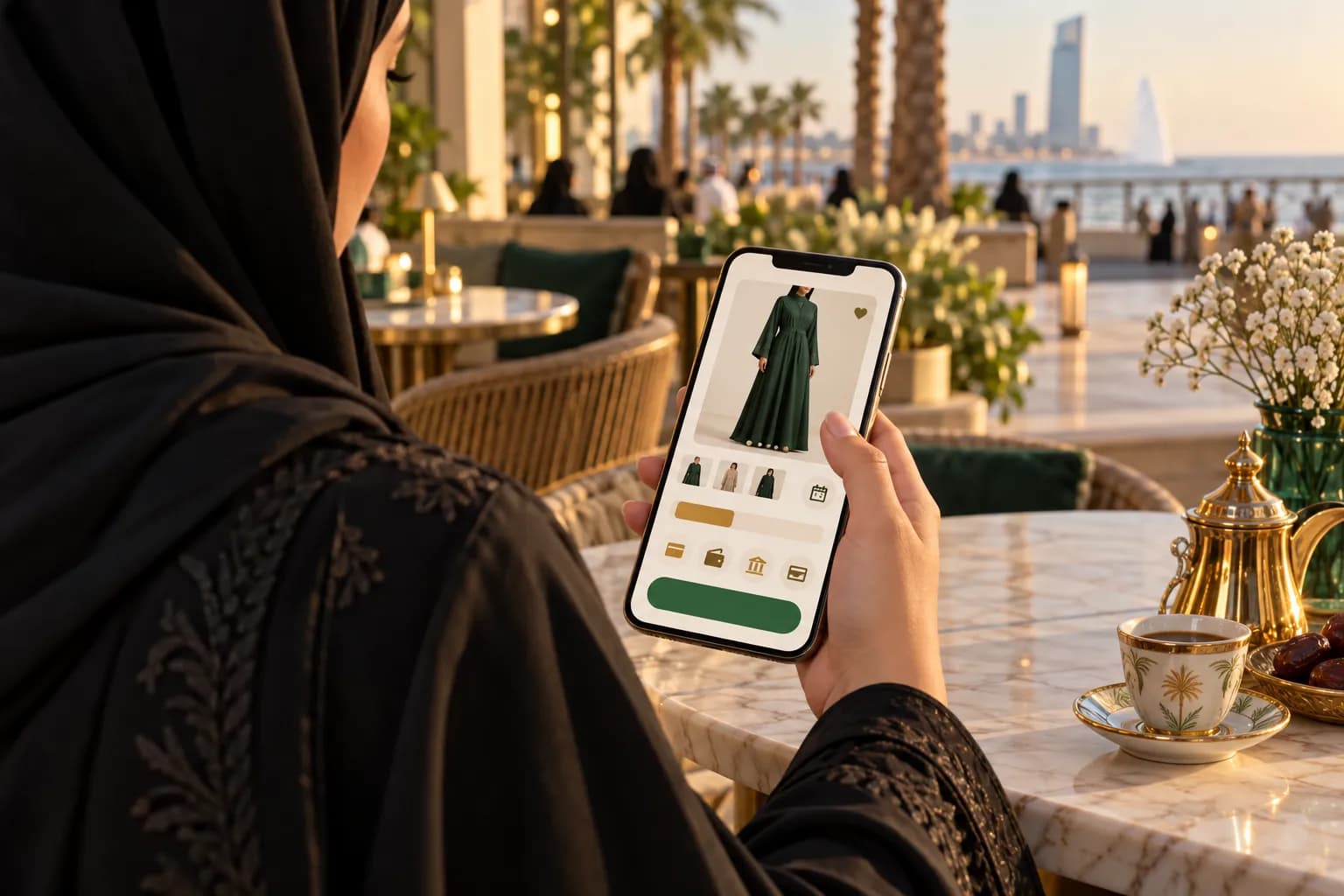
Need local shoots? Browse our directory of product photography studios.
9. Business details the law requires
The E-Commerce Law asks every store selling to Saudi consumers to show who it is. That covers your identity and contact details, your CR and VAT numbers if you have them, a privacy policy and a complaints process.
Put them in the footer, so they appear under every product page. If you've authenticated your store on the Saudi Business Center's Business Platform, show the certificate badge there too.
Shoppers who doubt a new store scroll straight to the footer. Make sure the numbers are there and the policy links work in Arabic.
To get the certificate, follow our Maroof and Business Platform guide.
How should a Saudi product page look on a phone?
Most Saudi shoppers will open your page on a phone, often straight from a Snapchat or TikTok ad. So design for a narrow, right-to-left screen first.
Here's the order that works on the first one or two screens:
- Image gallery, swipeable, with a video if you have one.
- Arabic title and star rating.
- VAT-inclusive SAR price, plus the instalment line.
- Size or colour picker, with a size-guide link right beside it.
- Delivery date for the shopper's city.
- Sticky add-to-cart button, with payment badges just below.
- One-line returns summary and WhatsApp button.
- Specs, description, reviews and FAQ further down.
Keep the page light. Heavy review widgets, chat bubbles and upsell apps slow it down, and some break in right-to-left layouts. Our mobile commerce guide covers speed and checkout in more depth.
Before and after: one product, two pages
Take a women's linen dress from a European brand, priced at USD 39.99 before tax. Here's the default listing next to a Saudi-ready one.
| Before (default foreign listing) | After (Saudi-ready) | |
|---|---|---|
| Title | Linen Midi Dress – Sand | فستان كتان ميدي بأكمام طويلة – بيج رملي |
| Price | $39.99 + tax at checkout | SAR 169, VAT included |
| Instalments | None | 4 payments of SAR 42.25 with Tabby or Tamara |
| Delivery | Ships in 7–21 business days | Riyadh: arrives Thursday · Other cities: 3–5 days |
| Payments shown | Visa, Mastercard, PayPal | Mada, Apple Pay, Tabby, Tamara, Visa/Mastercard, COD |
| Returns | See our policy page | Free returns within 14 days. Request on WhatsApp |
| Contact | Email form | WhatsApp button with a +966 number |
| Reviews | English reviews from the US | Arabic reviews with city and photos |
| Size guide | US sizes, inches | Arabic chart in cm, with EU/UK sizes |
| Model photo | Sleeveless, short cut | Long sleeves, layered with a light cardigan |
The product didn't change, but every question a Saudi shopper has is now answered before they scroll.
Saudi product page checklist
Work through this list on a real phone, in Arabic, for your top-selling product first.
Notes for fashion brands
- Size is the question fashion shoppers ask most. Put the size-guide link right beside the picker, not under the description.
- Add model height and the size they're wearing under each photo.
- Pull a "fits true to size" or "runs small" summary from your reviews and show it near the picker.
- Modest-styling rules matter most in this category, so plan them before your shoot.
Notes for electronics sellers
- List voltage, plug type and warranty in the Arabic specs table. Saudi Arabia uses the 3-pin BS 1363 plug.
- Show the SASO or SABER conformity details where your product needs them. See our SABER guide.
- Say who handles warranty claims inside Saudi Arabia. "Warranty: 1 year, serviced in Riyadh" beats a bare "1-year warranty".
Notes for cross-border sellers
- Selling through noon or Amazon.sa? Their seller ratings and fulfilment badges do the job a Business Platform certificate would.
- Price in SAR with VAT included even when you ship from abroad. Personal orders under SAR 1,000 pay no customs duty, but VAT and a customs fee of at least SAR 15 still apply.
- Selling from China or the US? Saudi Arabia's E-Commerce Law still applies to you, so the price and disclosure rules are the same.
Frequently asked questions
Yes. Both marketplaces show Arabic listings to Arabic-language shoppers, and Arabic searches match Arabic titles best. Fill the Arabic title, bullets and specs yourself instead of leaving them to auto-translation.
Sources & further reading
- E-Commerce Law and Implementing Regulations — Saudi Ministry of Commerce
- Product price on the shelf includes VAT — Saudi Ministry of Commerce
- Guideline on Professional Services under VAT Provisions (VAT-inclusive prices) — ZATCA
- Discount licence e-service — Saudi Ministry of Commerce
- E-commerce in Saudi Arabia: funnel sample data — ECDB
- Cart abandonment rate statistics — Baymard Institute
- Desktop vs mobile vs tablet market share, Saudi Arabia — StatCounter
- Can't Read, Won't Buy: B2C — CSA Research
This guide is for general information only and is not legal, tax or financial advice. Rules and fees change — always confirm with the official source or a licensed advisor.

Maya is MiddleEastEcom's lead guide and editor. She researches GCC marketplaces, payments and regulations and turns them into practical playbooks for sellers.
Meet Maya